


|
|
| Leaf and Flowers in various stages |
|
|
| Full open flower |
|
|
| Vibrant branch |
|
|
| Pollinating insect |
|
|
| Flower Cluster |
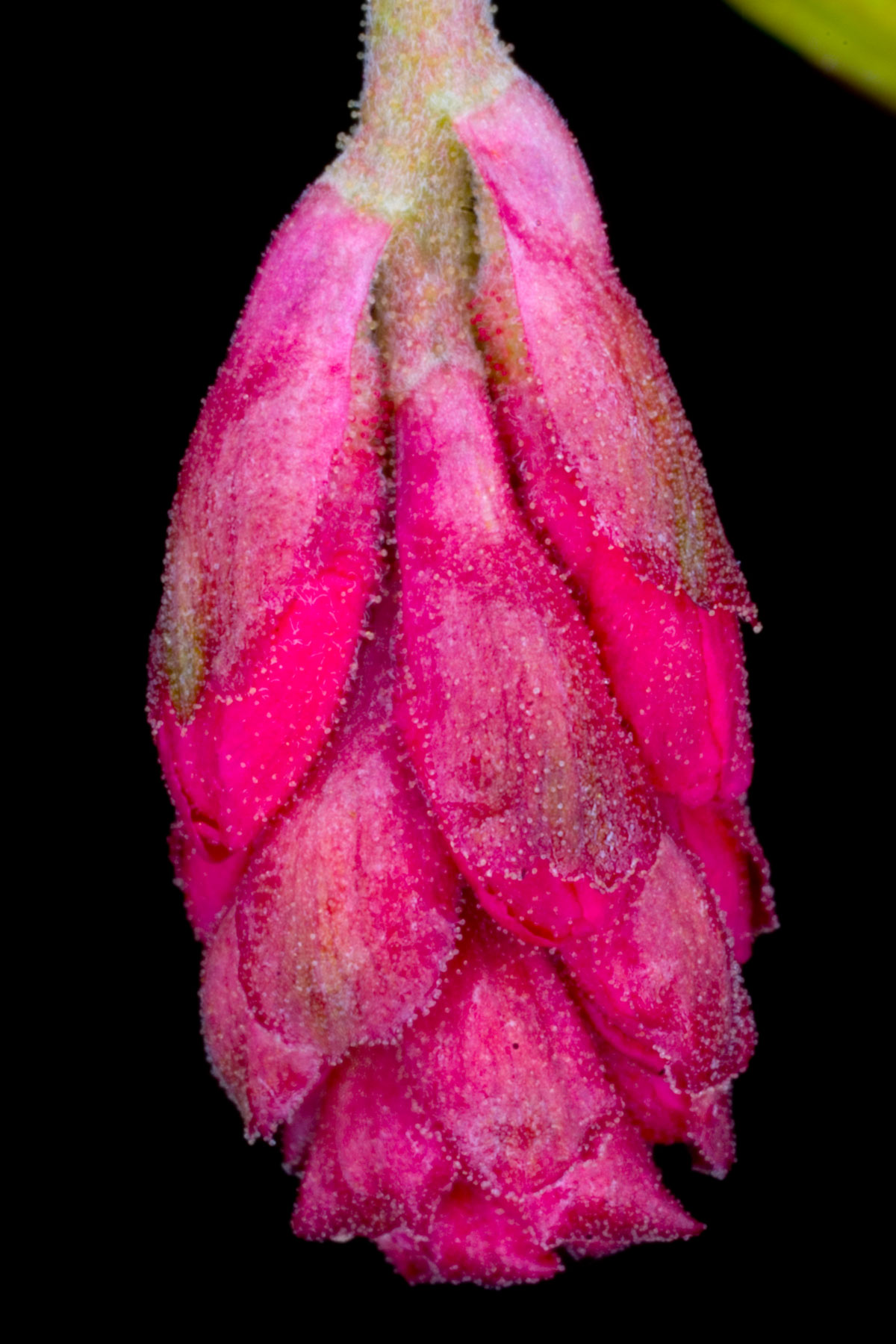
The red flowering currant is one of the joys of the coastal region of the Pacific Northwest from British Columbia to California. It is a shrub that comes back quickly after forested area is opened up to sunlight and and grows prolifically for 10 or 15 years and then dies out. It is relatively shade intolerant. It will provide one of the first signs of spring, however. The flowers begin to show red in March and precede most of the leaves. As the season progresses the leaves will appear and new growth chutes will grow. It is a woody shrub not bothered by livestock (deer, elk, or cattle).
As the name implies it will produce small berries before the season is up. They are considered edible, but are not suitable for eating due to their taste.
The vivid colors in early spring are always special however.

|
| Colorful buds |

|
| Precede the leaves |

|

|
|
The flowers are quite small, with the pedicels 5-8 mm long; Calyx bright red, the cylindric tube 3-4 mm. long with the spreading lobes 7-8 mm. Pedals are more to the pink and 3-4mm long. Stated simply, the very first thumbnail photo is pretty close to actual size, with the full frame photo of the flower being considerably enlarged from real life as it is taken with a 50mm macro lens which is capable of 1:1 viewing extended as far as possible with a macro 20mm extension tube added.
The leaves shown here are of 3 lobes, but 5 lobed one exist also, with 5 lobes being one of the trade marks of the Gooseberry family of which this is a part.