Pentax Converters

|
| HD Pentax-DA 1.4X AW |
|
| Pentax Converter A |
|
| Pentax Adapter F |
|
| Sigma AF Converter |
Converters, Teleconverters and Adapters
HD Pentax-DA 1.4X AW
The HD Pentax DA 1.4x converter appeared on the market in March fo 2014. It does everything that it ought to do. It's optical quality is well respected even though converters 'do their thing' by magnifying the defects in the lens to which it is attached. It includes weather sealing, and the HD coatings. It works and supports both Pentax styles of auto focus---the in body type(screw) and the SDM (focus motor in lens). It reduces the F stop rating of your lens by 1 F-stop (and reports the slower number in the viewfinder. It also increases the effective focal length of the lense by 40% and reports that higher number appropriately.
It works with all DA lenses except a few short focal length lenses: smc Pentax-DA 15mm F4 ED AL Limited, HD Pentax-DA 15mm F4 ED AL Limited, smc Pentax-DA 21mm F3.2 AL Limited, HD Pentax-DA 21mm F3.2 AL Limited, smc Pentax-DA 40mm F2.8 XS. The problem with these short lenses is a physical conflict between the back of the lens and the converter. Pentax doesn't document the older lenses that don't work, but I would look carefully,on older lenses for any optics that protrude out the back of the lens---profoundly wide angles. Of course using a converter on a short lens classifies as weird anyway. Normally one doesn't use a converter except on the longest lense they own, and hopefully that isn't an ultra wide.
A final thing to remember about a converter when used with auto focus is that auto-focus isn't happy with effective lens speeds much less than f5.6--maybe f6.3, so one must take into account the fact that the converter eats a full f-stop so f-4 or faster lenses are the lenses of choice for a converter. The preferred home for a converter is a "long-fast Prime" lens. Cheap zoom lenses along with wide angles are probably the poorest choices for use of a converter. Stated bluntly, the DA* models are the lenses of choice for this (or any) converter--and the longest one you can afford. The DA*50-135 and the DA*60-250 perform admirably. I should also mention that this converter isn't supported by early digital camera bodies. Only bodies produced since this converter was released are supported: Pentax K-3, K-50, K-500, K-30, K-5 II, K-5 II s, K-5, K-01, K-7, K-r (all after firmware update). For some sample photogaphs with various converters see Really Long shots with Converters.
Pentax Converter-A 2x-L and 1.4x-L
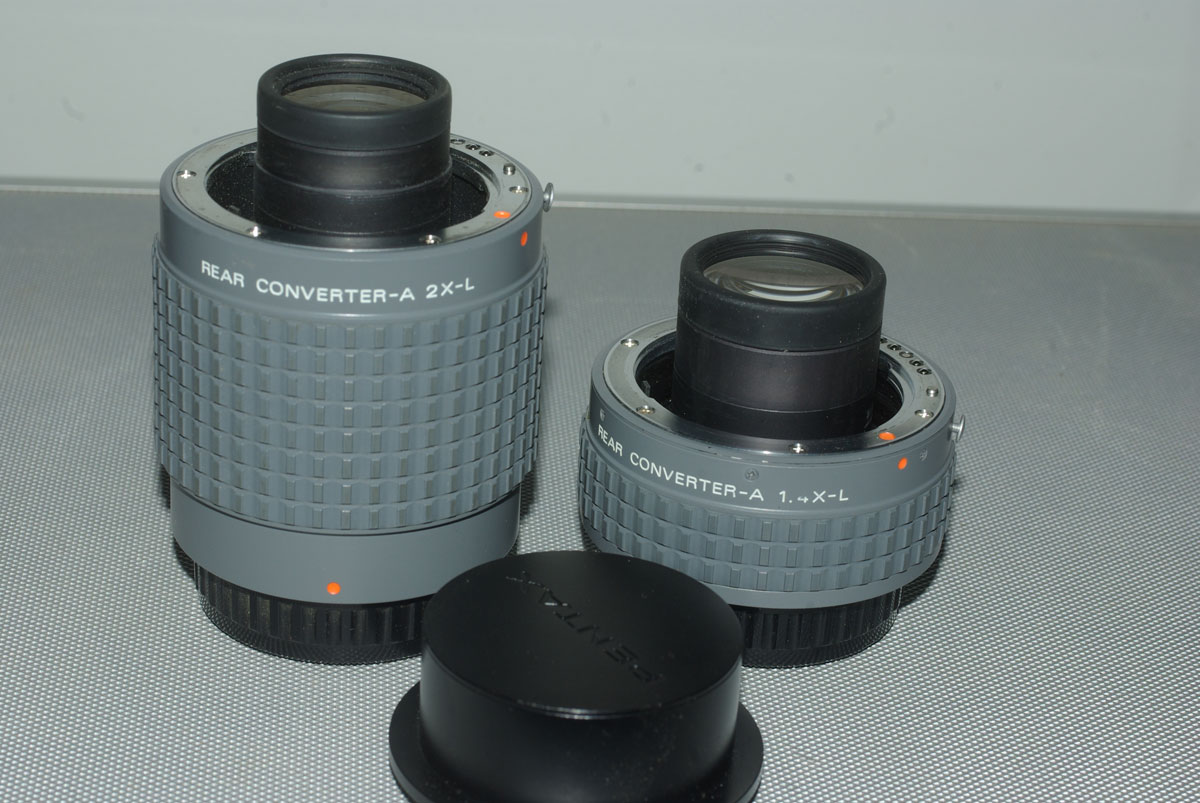
One of the dirty words in photography is "teleconverter" or "converter". Pentax even used the name "Adapter" for one they made. You see 4 of them here--all different. The first 2 were made by Pentax for about 20 years beginning in 1984. One is a 1.4x model and the other is a 2.0x model. The number has to do with the amount of magnification it does to the focal length. Translated, the little one will add 40% to the focal length while the big one is a lense 'doubler' and will add 100% to the focal length--Thus with it a 300mm lens becomes a 600mm lens. Both of these first two 'converters' are '-L' variations. There are also '-S' variations. The dash "L's" are for long lenses--300mm or longer. they won't fit the shorter lenses because of the protruding optical unit you see sticking up. There are not a lot of them around because they effectively dedicated to some very expensive extreme telephoto lenses, but as you might surmise they work quite well with them.
As you might guess they are not a free lunch. They do their thing by by sort of magnifying part of the image collected by the lens as they mount between the camera and the lens. The process degrades the quality of the image by magnifying the optical limitations of your lens, and also reduce the lens speed as they discard part of the image collected by the lens. The 1.4x can be expected to make the effective speed of the lens 1 stop slower while the 2x will take around 2.5 stops of light away. Some converters can be stacked, but these two shown in the first photo mechanically will not stack though either one can be used in conjunction with either of the other two--if you put the 'dash L' one on the lens first.
Stacking them will compound your light loss and image quality issues, but also reach way out there which can be the only solution to small birds and shy animals in the wild. Your own experience may vary and will depend closely on the quality of the optics that you have. The very high quality and fast optics that Pentax custom made in the 1980's are the target market for these converters. Most people report that with the 1.4x-L they cannot see significant quality degradation, so when applied to the 300mm F/2.8 lens, the result is effectively a 420mm F/4.0 lens an extremely useable combination. Like wise the 2.0x-L takes the same lens to a 600mm f/6.3 with pretty minor quality degradation. If you start out with a 600mm base lens, then you see what happens. A possible downside to these converters is that they are designed for the A series lenses, and no auto focus support was ever provided in them, though with the extreme telephotos many prefer to manually focus anyway.
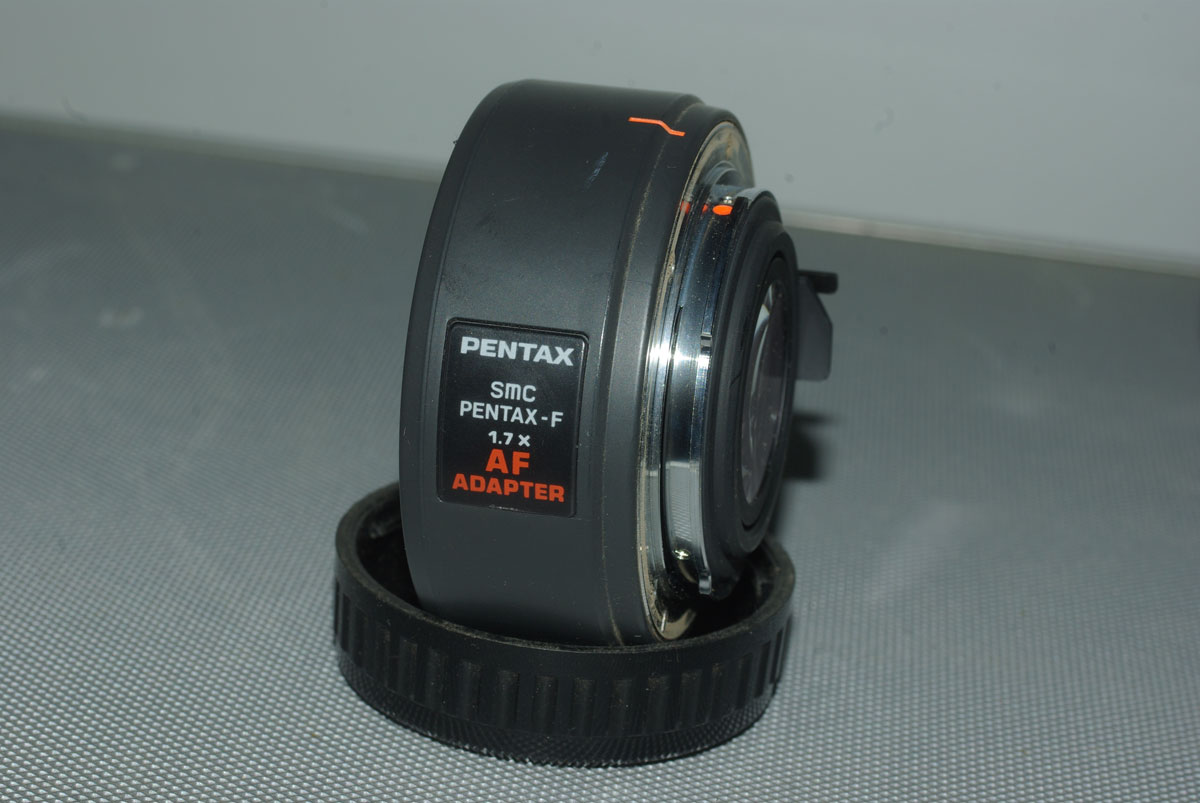
Pentax 1.7x AF Adapater
This device is one of the more interesting pentax creations. It's called an AF adapter, but in the process it is also aa 1.7x teleconverter. It is intended for placement between Pentax-A (manual focus lenses) and Pentax AF (autofocus) camera bodies. Nominally,it will increase the focal length of the lens bly 70% and also convert the lens to autofocus. Actually, it doesn't do anything to the lens, as you set the focus of the lens to 'infinity' and it stays there, but the autofocus drive moves the optics around in the 'adapter' which effectively changes the focal point. It's focal range is less than the manual focus range so if the target is too close it won't work. While it has the predictable 'costs' in terms of lost F-stops and optical resolution, it actually works reasonably well if you are photographing 'close to infinity', but gets less happy on the close end of things. You can manually back the manual focus back from infinity, but life gets more complicated. Recently with the resurgence of Pentax and the shortage of new lenses, these 'Adapters' have been much in demand. It has no optics sticking in the back of the lens and will therefore mechanically work on any Pentax lens. It will even work as expected with the new fangled Pentax SDM lenses.
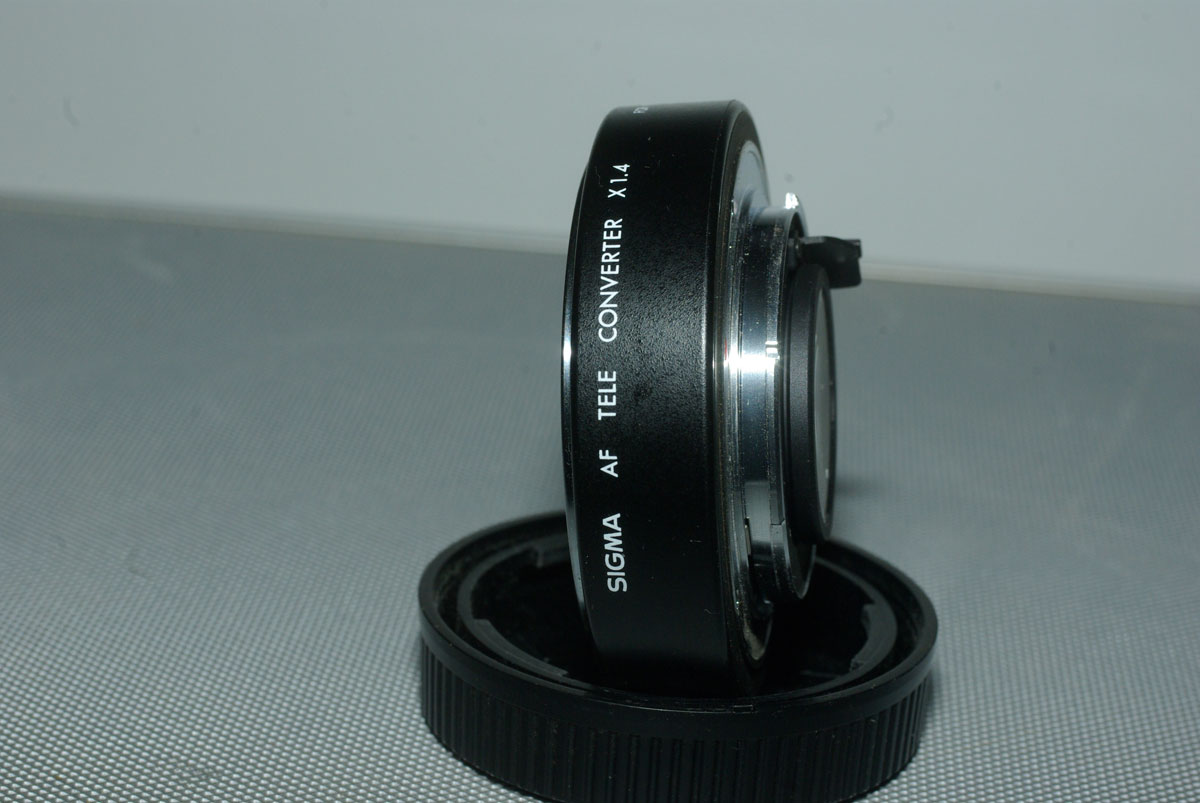
Sigma Full AF 1.4x Converter
The fourth photo down is a Sigma full autofocus converter. It has a drive shaft all the way through and will support autofocus lenses. You have to be careful however. The camera has no clue you have done this and still thinks it has the shorter length lens attached. Similarly the readings of the F stop are literal--i.e. where the lens is set, but its a lot darker so it is pretty easy to fall off the bottom of the AF sensitivity range which means that your AF goes bezerk. It is not happy with an SDM lens however. They will need to be focused manually as nearly as I can tell.