Pentax DA Digital Auto Focus System

|
| Pentax *istD Body |
| All photos with blue borders expand if clicked |

|
| Pentax K10d Body |

|
| Pentax K7 (July 2009-September 2010) |
|
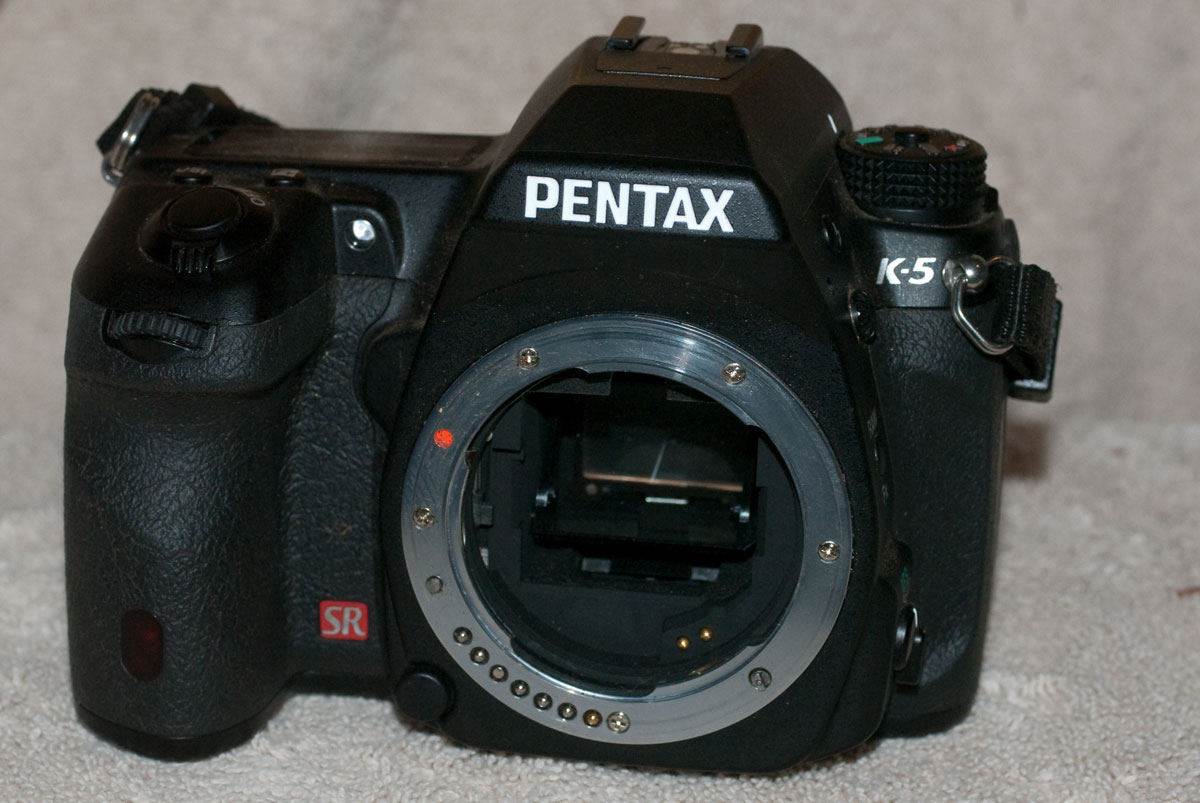
| Pentax K5 16 megapixel camera was introduced in the fall of 2010 in time for Chrismas sales. Unfortunately, it had quite a few early quality control problems. these were largely resolved by Christmas and the post Christmas production has proven much better. The sensor with its ability to work at relatively high ISO levels set a new standard for SLR type cameras. Early issues related to Auto focus accuracy followed by discovery that many early sensors developed the ability to take photos that looked like they had water spots in the middle of the photos which was attributed to quality issues in the sensor (which Pentax does not make). The user is now allowed to calibrate the focus of each lens they have in the software menus which has quieted the complaints of 'front' and 'back' focusing. |
|
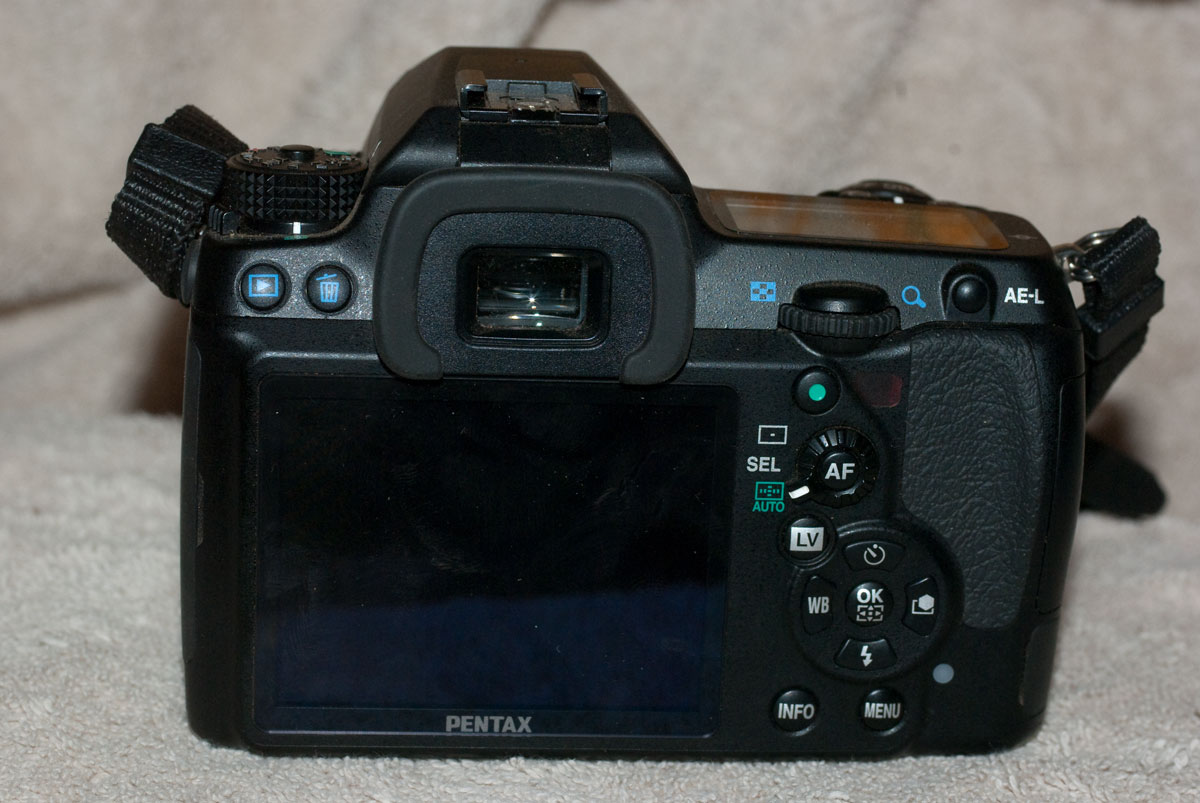
| K5 Rear View |

|
| Pentax DA 21mm Limited |
|
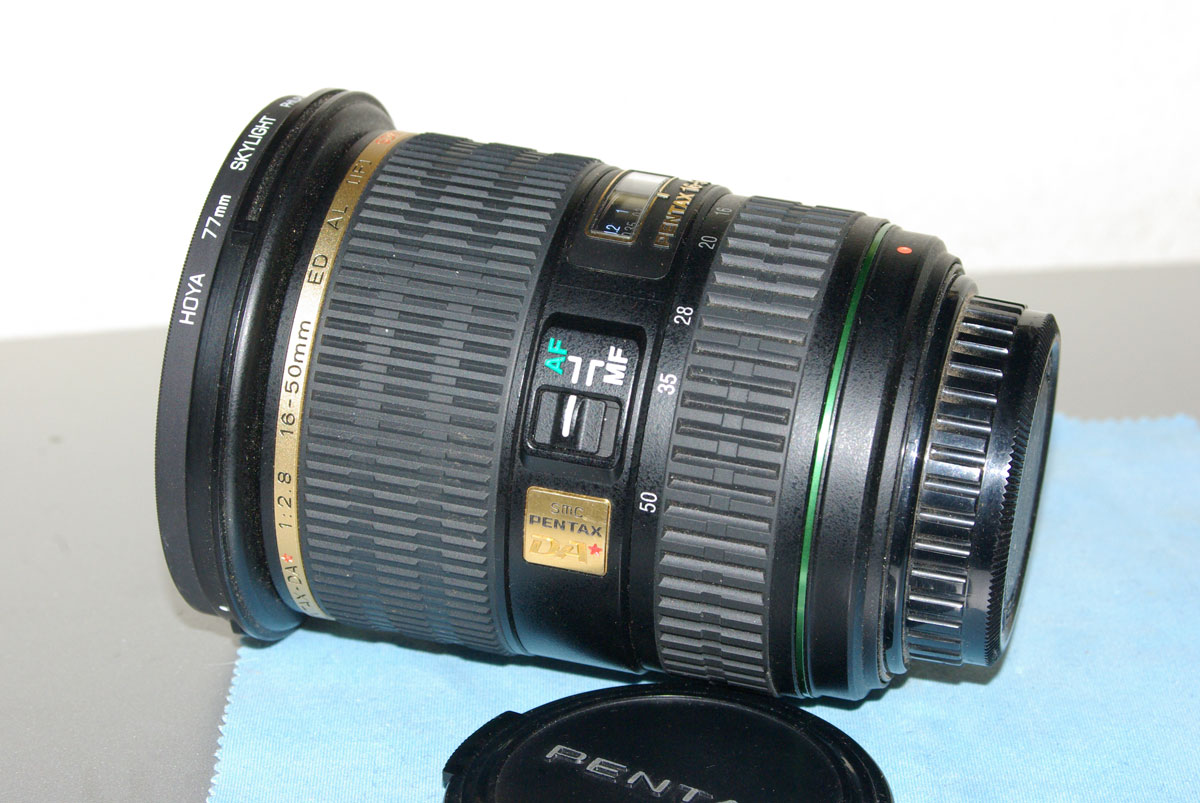
| Pentax DA* 16-50mm SDM F/2.8 Zoom |
|
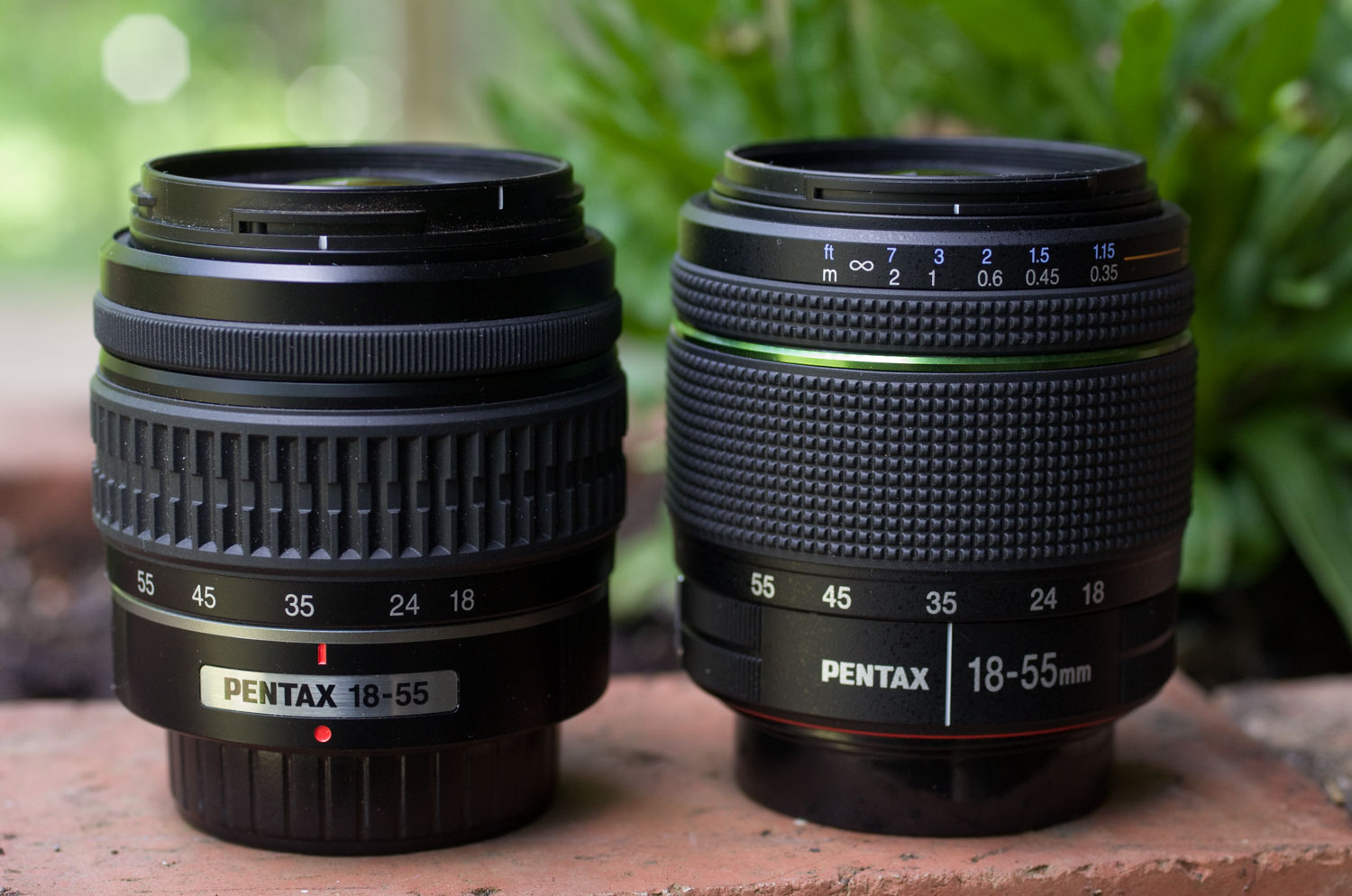
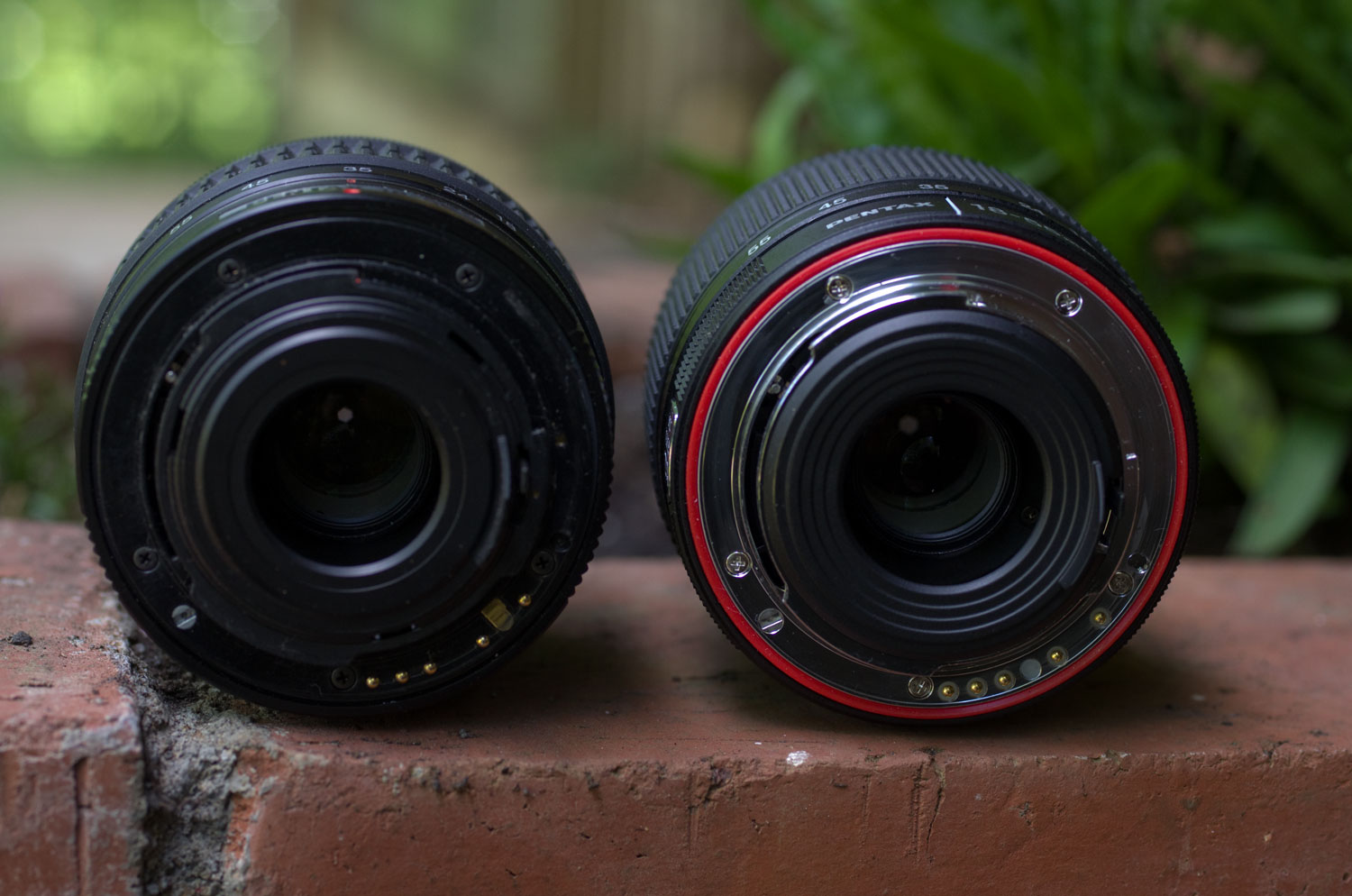
| Pentax DAL 18-55 and DA 18-55 WR. Some version of the 18-55 f/3.5-5.6 is the 'standard' lens for Pentax digital SLR's. Many of the cameras are sold in 'kit form' implying that they come with a lens so you can actually use them. Others are sold 'body only' and you have to furnish you own lens or buy one separately. In Pentax speak lenses labeled DAL are the "low cost" ones. The DAL version is shown on the left. It is machined for a weather sealing O-ring on the mount but the seal is not provided. Lenses marked 'WR" are so marked because water seals have been added to them to reduced the risk of harm if the camera is used in hostile weather. The WR doesn't mean that you can drop the camera in the river, recover it, and not have a problem. It does mean that you should be able to stand out in the rain and take a photo without concern about the destruction of your camera. |
|
| Pentax DA 18-55 rear view |
|
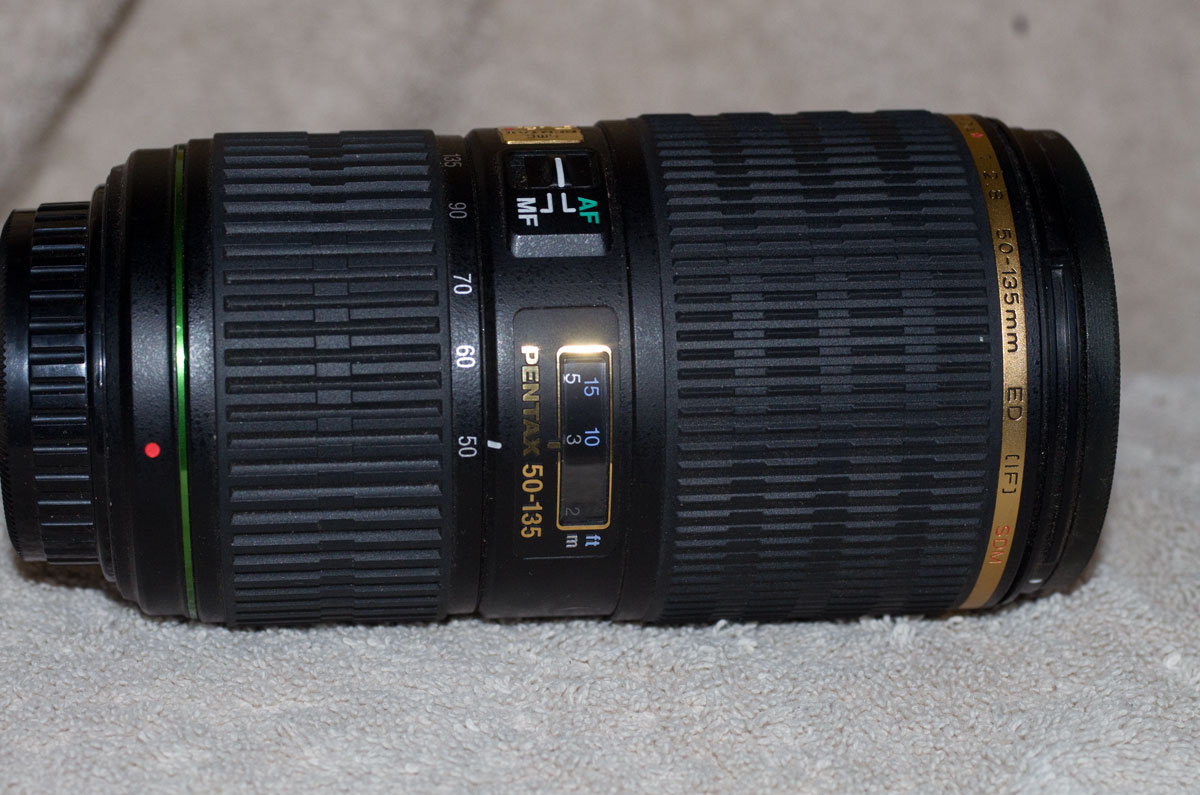
| Pentax DA* 50-135mm SDM F/2.8 Zoom |
|
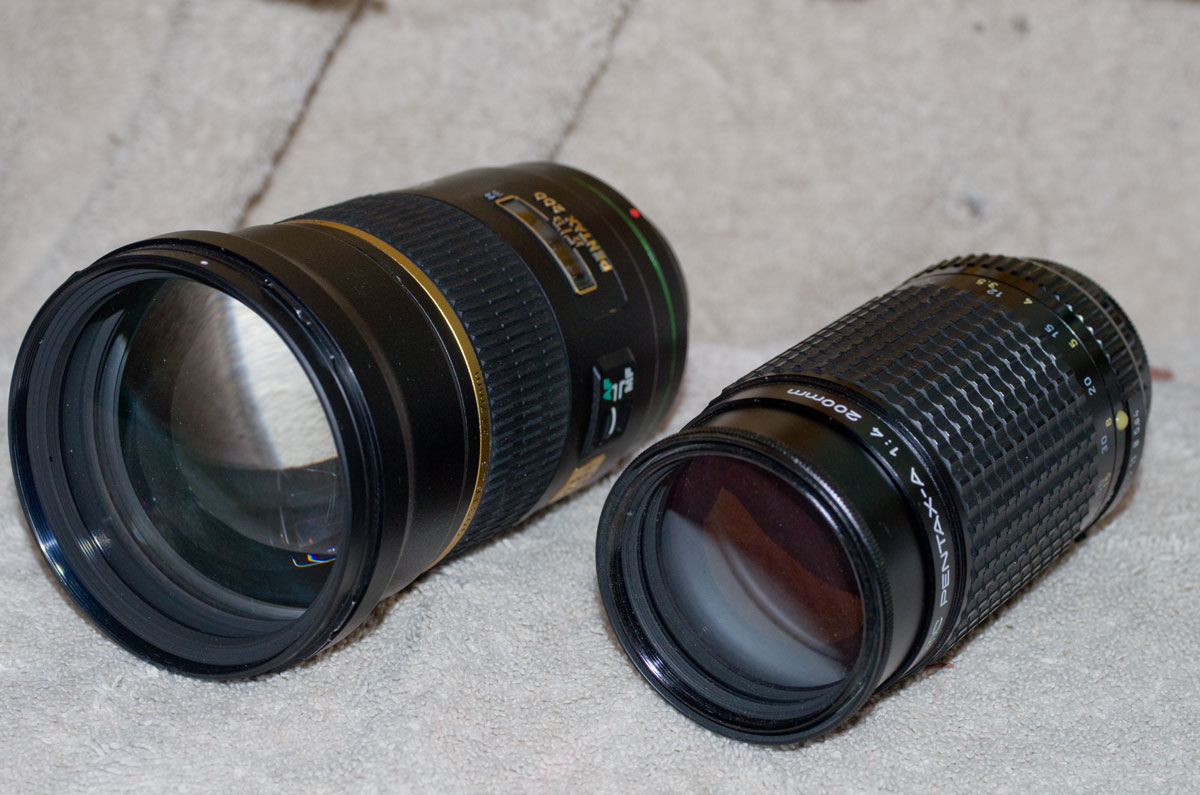
| DA* 200 SDM (left) |
|
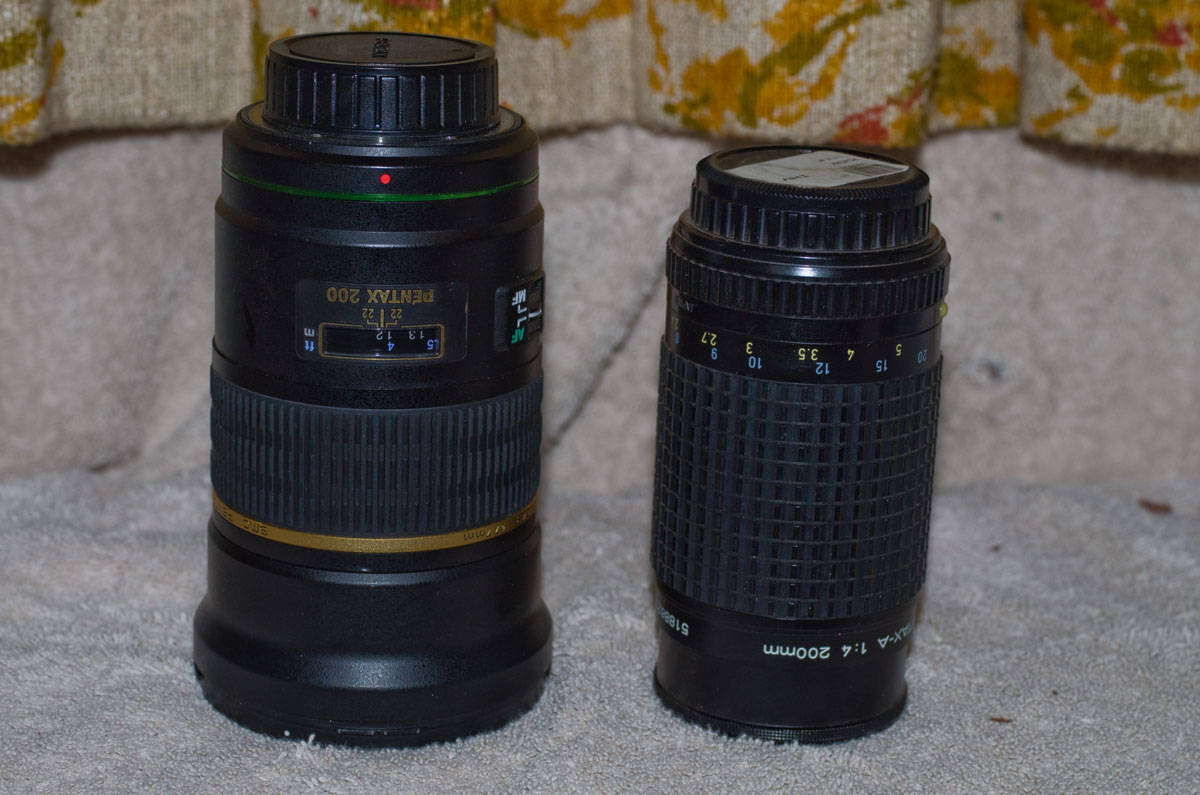
| The DA* 200 SDM f/2.8 is shown here along with the classic Pentax-A 200 mm f/4. As shown it is a fairly hefty lens, but this illustrates also that adding an 'F stop' of speed is not trivial. It uses a 77m filter size in common with the 50-135 and the 16-50 DA* lenses. |

|
| Pentax DA 50-200mm F/4~F/5.6 Zoom |
|
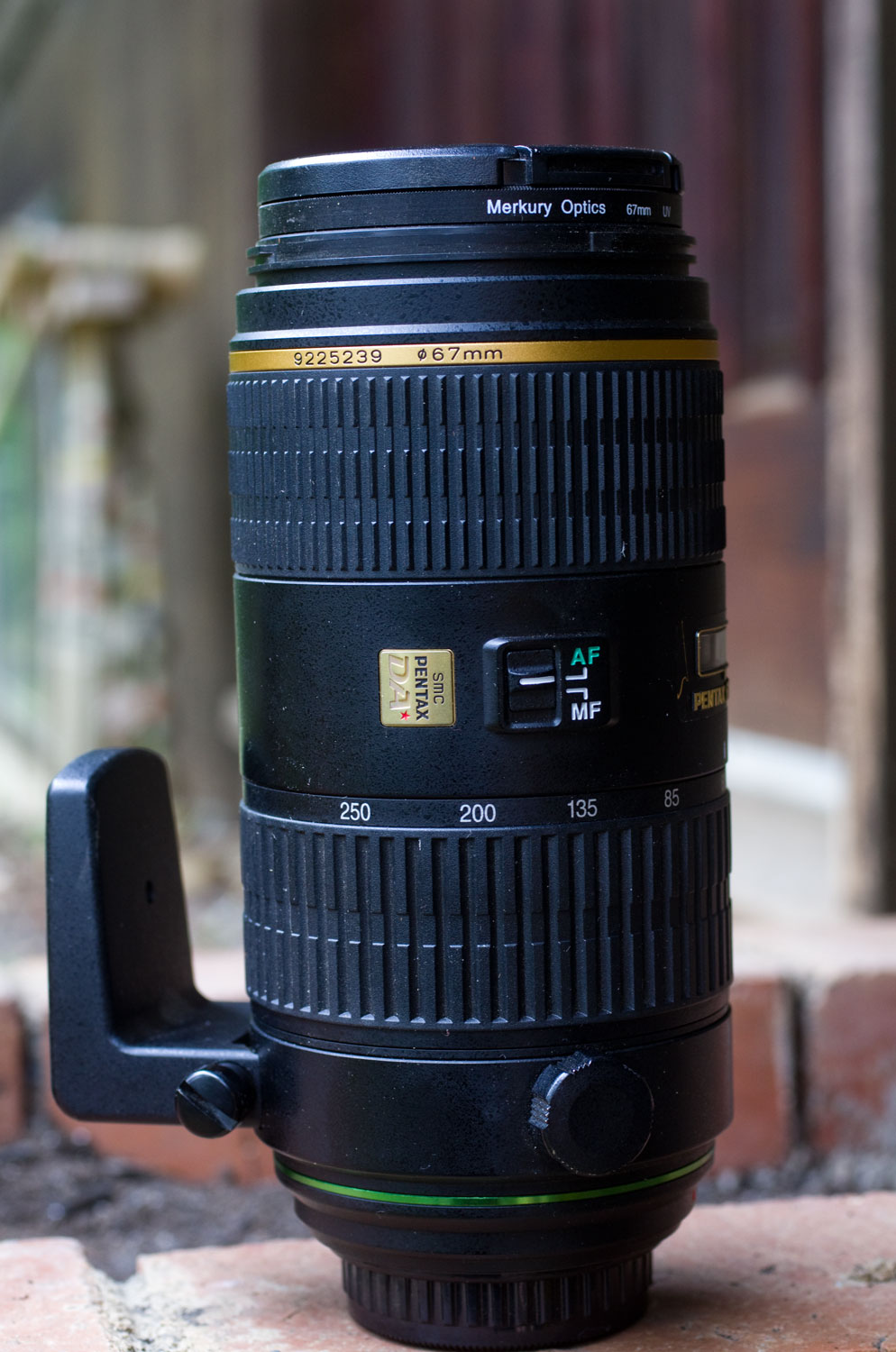
| The DA* 60-250 SDM f/4.0 is shown here. It features a removable tripod mount. It does change length when zoomed, but does not change length or rotate when focused. |
|
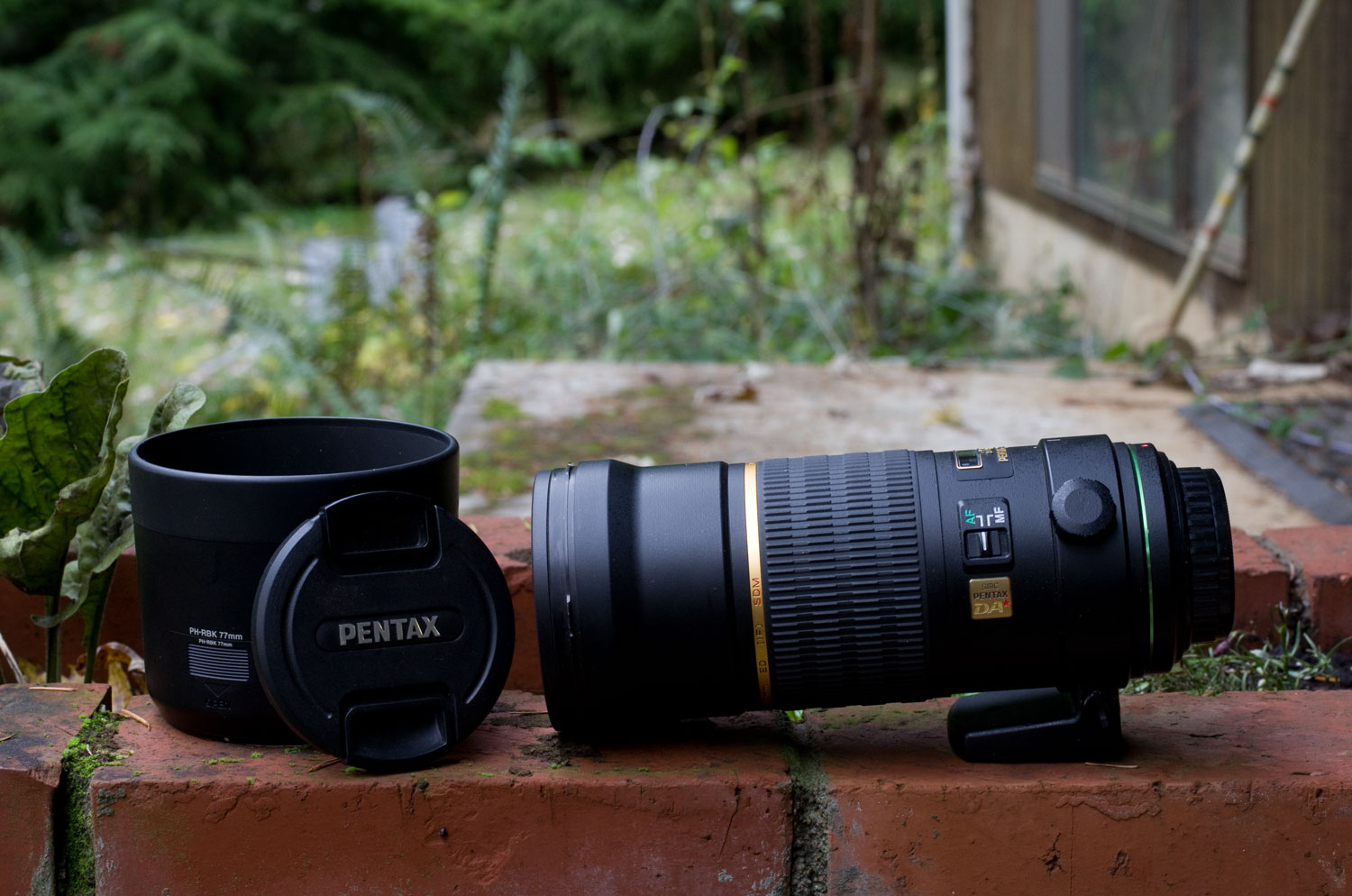
| The DA* 300 SDM f/4 is the latest in a long line of excellent 300mm optics from Pentax. This is a rather nice lens for many purposes. The quality is worthy of the DA* marking, and the size and weight are reasonable enough to easy handholding. What's missing is that Pentax has historically offered a faster (f/2.8 exotic 300) lens and also a longer option ( 500 or 600 mm lens). So far there has been no hint of such upscale optics in recent years. |
Pentax belatedly entered the digital world in 2003 with the *istD digital camera. I bought one fairly promptly as I had Pentax lenses around, and wanted something to provide for better photos for this website, and digital photos are ever so much better than scanned ones on a website. This *istD came out at 6.1 mega pixels, and was replaced by the K10D at 10 mega pixels in 2006. I had to have one of those as well but held off until 2007 to get it (after a price drop or two).
I was a little shocked at the robust size of the K10D, but it is OK. IT turns out that its mass makes some of the heavier lenses I have balance better. A light camera body with a heavy lens is an ugly combination. The auto exposure on the digital bodies is often wrong, apparently because the digital 'tolerance span' is narrowing that the exposure latitude with film. This is compensated for by the fact that you can instantly see the results of your photography and can easily bias the exposure by holding down the exposure bias button and rolling the front control dial. You can do this without even loosening your grip on the camera as it only takes a thumb and finger to do it.
The big thing to understand in the digital family is the 'sensor size'. Point and shoot cameras even though they advertise high pixel counts will NOT provide the same quality photos because their sensors are smaller. Smaller sensors allow for smaller lenses and overall less cost. The ultimate detail in the photo is a combination of the sensor size AND the mega pixels. The Pentax SLR's here do not use a 35mm sensor (now called FF for full frame). They use an APS-C sized sensor -- the size of a failed mini SLR size that the industry tried a few years ago with film. Lenses used with this smaller sensor have a different field of view than they did with 35mm film. Indeed you can add 50% to the focal length in MM and will get the right answer so the first lens listed as a 16mm to 50mm zoom actually when used with a digital body has a field of view consistent with what you saw on a film camera with a 24-75 zoom lens.
Long telephotos are of course longer. More to the point since the sensor is smaller the lens can be smaller and still provide light all over the sensor. This is suppose to mean that lenses can be cheaper, but with the high pixel counts of the sensors, it also means that the optical quality has to be high, as the pixel counts of the sensors are now plenty high enough to 'record' the results of poor optics visibly. The 'DA' series lenses are specifically made for the smaller size sensor and though they will mechanically fit the film cameras, your photos will have 'black corners' as the optical foot print of the DA lenses isn't big enough to reach the corners of the 35mm film.
Also the DA lenses have no 'aperture ring'. You can adjust the aperture if you want with a control wheel on the camera body but the aperture ring has for the most part been set to 'A' since 1983 when the 'A' position was introduced, and now the mechanical aperture control is history.
The bag of tricks here presents 3 very different DA lenses. The 21mm Limited lens is a 'pancake' lens, so called for it very thin physical size. Pentax offers pancake primes in several focal lengths. This just happens to be the wide angle version. On the other hand the DA 50-200 is a low cost and very small f/4.0~f/5.6 zoom. The speed is nothing to write home about, but the size and cost are small and low. It is scarcely larger than a 50mm macro lens. At the other extreme is a new generation DA* 16-50mm F/2.8. The exciting new feature of it is the SDM focusing. Instead of doing the focusing via a cam drive through the lens mount from a motor in the camera body, the lens has its own motor powered by the two barrel mounted contacts of the KAF2 mount. This makes the focus SILENT and fast. No more whirring of gears to get the focus done. Usually the focus happens to quickly that your eye doesn't even notice, and without noise to scare off that which you wish to photograph. Canon uses this method exclusively in their SLR series cameras now and Nikon has like Pentax offered it in some high end lenses. It is expected that it will be offered in high end Pentax lenses in the future but apparently not in all lenses implying that the cam drive focus technology that has been around since 1987 will stay around for a while longer. Presently the SDM lenses will work with the cam system on digital bodies that do not support SDM which presently include all digital SLR bodies except the K10D and the K100 super.
The digital SLR's have been immensely popular and have been selling in very large numbers of late. By most reports the K10D has been a smash hit because of its high feature content and low cost. However, the digital technology is still evolving rapidly and the feature war is on between manufacturers with a 14MP model expected from Pentax during 2008.
Pentax discontinued their FA line of lenses in 2004 and has been slow to replace them with DA lenses. They now have the the short focal lengths well covered but have been behind in getting long lenses for the DA series into production reportedly because of manufacturing issues with a factory they own in Vietnam. SDM lenses are announced in 200mm F/2.8 and 300m F/4.0 but not yet delivered.
Dateline June, 2011
Since I first wrote this article about 3 years ago in the spring of 2008, the world has continued to slog forward in the digital camera field. The Pentax K10D gave way to the Pentax K20D, which gave way to the Pentax K7 which in turn gave way in September of 2010 to the Pentax K5 as the flag ship model. The K5 and K7 are nearly identical in appearance. One has a differently shaped button, and a couple of butttons are labeled differently to reflect that the K5 lets you change the function of some buttons in the software. Pentax seems to be on an 18 month cycle in upgrading their flagship camera body. Meanwhile they have produced some down line models as well.
Every new model has to have some new features. The K20D picked up the digital resolution to 14.6 megapixels while the K5 (introduced in the fall of 2010) changed sensors and went to a 16.3 megapixel digital resolution. While the K20D largely shared a body with the K10D, the K5 shares a body with the K7. Perhaps the biggest deal of the K5 and it's new sensor is support for greatly increased ISO levels. The MAX ISO setting on the K7 was ISO 6400 and even that peformed badly. The K5 kicks the ball down the road with support for ISO levels up to ISO 51200, and depending on your appetite for noise you can actually use elevated ISO levels ( I use routinely ISO levels up to 3200) Likewise the camera throughput has been enhanced permitting the support of a reasonable 'movie mode'.
The k5-K7 body has lost some size---almost back to the "ist-D" size and has lost some weight as compared to the K10 as well. I've found the K5 to be a major improvement in a number of respects over the K10D which is the model I actually have experience with. The really big deal, of course, is the high ISO. The K10D maxed out at ISO 1600 and that wasn't a speed that you thought much of the photos, though I did allow the AUTO ISO to select ISO settings up to 800 which was pushing the envelope. I've now set my AUTO ISO range to ISO 3200 and wouldn't hesitate to push up beyond that when called for.
Also Present is the 'movie mode' which is something new to me, but of interest as I have had the urge to add movie snippets to this web site. It's a whole learning issue by itself, but with the introduction of HTML 5 supporting browsers (IE 9 and Firefox 4) in early 2011, I think every current version browser has support for HTML 5. Unfortunately the movie CODEC war goes on, so although the "VIDEO" tag is supported, within the "VIDEO" tax there is little consensus as to what file format to use.
Pentax struggles in the Digital SLR market as they did in the Film market as an also trying to compete with the market dominants, Canon and Nikon. They need to match "Canikon" as the market leaders are sometimes called in features and price or they won't sell, but their small market share makes it hard to spread the R & D costs, although the growing practice of all manufacturers of using 3rd party sensors is likely helpful to the smaller manufacturers, but it also creates a dependency.
Pentax has finally produced the long ago announced longer lenses, a DA* 200 F/2.8, DA* 300 F/4.0 and the DA* 60-250 F/4.0. They are also marketing a variety of 'cheap zooms' up to 300 mm. Recently, I have added 3 DA* lenses to my collection including the DA* 50-135 F/2.8 which was an upscale mate to their original DA* 18-50 F/2.8. which I have long owned. Along with it, I've rounded up a DA* 200 f/2.8 and a DA* 60-250 f/4 Zoom. All are a suburb performers and worthy of the DA* designation. Although not a 'birding' lens when you consider the 'crop factor' of the Digital format the DA* 50-135 field of view is similar to the historically popular 80-200 zoom which use to be in the camera bag of every 35mm film camera.
It remains totally unclear what the strategy of Pentax is with respect to the SDM technnology which relies on a motor in the lens for focusing instead of the traditional 'screw drive' focus method which locates a motor in the camera body. Pentax has continued to produce both types of lenses, with the upscale ones usually being SDM, but the 'consumer lenses' have been a mix. I had rather suspect that Pentax might stop supporting the screw drive in their new bodies at some point and strand the 20 year legacy of screw drive lenses but there is no indication of that now.
What's Next
Presently, these SLR models have a flop up mirror and an pentaprism, providing, if you will, a 'mechanical view' of your photo target. Recent trends indicate that Pentax will soon introduce some EVIL models as they are called which will 'live view only'. Since no 'mirror box' is required or pentaprism, they can be considerably smaller and mechanically more simple. Rumored now is a very small series of EVIL's (akin to the 110 SLR), but we are also expected a larger series. What remains to be seen is whether these lower priced cameras will displace the SLR family which so far has been driven by its ability to use lenses from the 35mm film cameras.
Dateline July, 2011
Two significant things have occurred in the last month. Hoya has sold the Pentax camera division to Ricoh. The Pentax name will be retained but it remains unclear what impact this will have on the Pentax product line. Secondly the EVIL body has appeared. This rendition is a very small body similar in size to the Pentax 110 SLR unsuccessfully introduced years ago as an SLR that accepted 110 film canisters. Most are assuming that Ricoh didn't buy the camera division just to fold it.
Dateline November 2011
Five months in since Ricoh came into the picture, there is still no news as to what Ricoh has planned. In some ways this is not surprising because the product development cycle is such that there has not been time for products inspired by Ricoh to come out of the pipeline and they wouldn't want to spoil Christmas sales by pre announcing products that couldn't be available by Christmas. The sum total of what has come out of Pentax for the SLR market is a GPS addon unit that will record the LON-LAT in the EXDIF of your digital photographs. Within the user group there is a deep division over whether Pentax should attempt a 'full frame' SLR as opposed to the 'half frame' or APS-C size that all the Pentax SLR digital's use now. Canon and Nikon are offered such products in the upscale market. Pentax, of course, has the 645-D, but that is way upscale. The big sellers are pocket sized cameras, and putting a 'full frame' (the size of the 35mm film) sensor would require a larger not a smaller body. The way, of course, to make a smaller body is to remove the mirror box, and rely on the electronic viewfinder only. Presently the lens mount and the sensor to lens mount dimension plus space for the mirror drive the dimensions of the camera.
A twenty-five year legacy of optics for the Pentax K mount (with usable Pentax lenses including every Pentax lens made since Pentax has been in business is both their best friend and worst enemy. The lens overhang sells cameras because there are lots of good lenses, but makes it hard to sell lenses, and impossible to change the mount because if they orphan the 'installed base', the whole reason for buying Pentax won't be there.
As I write this the market for film based stuff has collapsed completely. I see good 35mm SLR film camera bodies on EBAY selling for $10 to $40--basically give away prices. Around 20 years ago, I made it a point to sell off my Pentax-M lenses and the old Pentax K lenses which did not have the "A" position on them anticipating that they would depreciate severely in value. They have, and while usable on the digital bodies, they are just barely so, and many of the exposure features are not available. More recently, I have made a similar decision about the Pentax-A lens family. They are fully functional on the digital KAF2 mount lacking only electronics and auto-focus. They do require that you input the focal length of the lens when you mount it as the only real inconvenience, but the hand writing is on the wall for these, and although I have quite a few lenses, I'm busy disposing of every manual focus lens that I have, except for the super long exotics that are not readily available in auto focus versions.
Dateline December 2012
The last 12 months have been interesting in the Pentax world. The first introduction of the the year was the K-01, a low end APC-C model. It has the K-mount, but lacks the pentaprism relying exclusively on the digital screen on the back of the camera for a view finder. Reputedly the Cell phone cameras have killed off the low end of the camera market and K-01 is intended as a 'big sensor' step up from the cell phone mini's. Unfortunately the K-Mount is made with the assumption that the lens is well forward of the sensor to leave space for a mirror flopping around. Removal of the mirrow didn't therefore mean that the K-01 could be made thin as the whole idea was to preserve the K-Mount, so the K-01 is a mirrorless camera almost as big as one with a mirror. I don't think it is a barn burner.
The K30 that was next released was much more interesting. Positioned into the middle of the market, it came in probably as good as the flagship K-5 with a few features missing. Notably Pentax separates their flagship from the down line models by providing a 'settings viewing window on the top right side of the body on the top of the line and omitting this on the down line models. The K30 introduced an upgraded focusing software and shared the same sensor as the K5 presenting an indtermediate class camera that sort of upstaged the top of the line model.
Pentax-Ricoh dealt with this with some price cutting on the K5 and finally discontinued it, only to bring back two versions of the K5 called the K5II and the K5IIs models at PhotoKina this fall to be marketed during the Christmas selling season. The K5II seems to have the focusing firmware upgrade introduced in the K30 while the K5IIs is notable for the fact that the Anti-Alising (AA) filter is not present. The AA filter built into smaller and lower resolution sensors is designed to manage Moire' which is a false color pattern that can be a problem. The filter trades a little blurring of the image for the removal of the possibility of this pattern. My assumption is that the marketing of two identical models but for this filter is a fairly short term test market to carry the model through the Christmas selling season and find out if people are willing to risk some Moire' in their photos in exchange for increased sharpness. I'm expect that spring will see a new top of the line model likely with a 24mp sensor (up from the 16) in the K5. I assume the new model will have even less Moire' issues than the K5II does, and if the introduction of both models side by side worked off the consumer resistance to dropping the filter, we'll probably see the new model with no AA filter.
What else may change is hard to guess. This will be pretty much the first model that is Ricoh only in design so if Ricoh had some ideas or priorities they may appear. There remain some opportunities for Flash exposure accuracy and focusing speed and accuracy, but whether those opportunities are addressed remains to be seen. The other big deal remains responding to the customer clamor for a "FF" model or Full frame. Other manufacturers have responded to this market which incorporates a sensor the same size as the 35mm film frame instead of the APS-C size (or half frame). The leading camera makers are producing such a critter as a top of the line body. This however involves more than just turning out a camera body, it requires a commitment to a lens line for the full frame. All the lenses left over from the film days will work, but fair number of the new DA glass does not support an image circle big enough to cover a FF camera. I'm thinking that during 2013 we will get pretty clear guidance as to where they are going.
Dateline August, 2015
They year 2013 brought a new flagship camera, the K-3 as expected. I upgraded immediately. It made standard thet absence of the AA filter, and introduced a 24.35 MP sensor along with improved low level light management. kWith improved dyamic range, it fulfilled most of the wish list that any photographer might have. Cosmetically and control wise the K3 was little different from the K-5.
Besides downscale models, 2014 did not bring much new to the table, but 2015 brought news of a committment of Pentax to produce a Full frame model in the future. In furtherance of this strategy 2 high grand long zooms, a HD Pentax-D FA* 70-200mm F2.8 ED DC AW and HD Pentax-D FA 150-450mm F4.5-5.6 ED DC AW. The latter was actually released, while the former asa of this writing has been deferred on account of engineering issues. the summer of 2015 has also produced a K-3II with a feature revision. Gone is the Built in Flash and in its place is a GPS, featurewise similar to the standalone addon that has been available for sometime, but with integration full geotracking is available for a brief time, just using the sensor antishake mechanics.
The technology for good electronic photography is getting more and more stable, and the camera in the cell phone has become better and better so annual product annoucments are getting more boring, and the ordinary persons camera is becoming the cell phone.
Dateline December 2015
Pentax faithful are looking for a full frame (FF) camera body widely expected to formally appear in february of 2016, and a less certain successor to the K-3 II which replaced the acclaimed K-3 in April of 2015. The II model is a look alike for the K-3 but contains a few new features that will likely become standard if the market accepts them. Most notable is the availablity of increased resolution through pixel shifting, and the replacement of the built in flash unit with a GPS unit. The DA format that has been used by all the SLR style Pentax's since the *ist-D have been so called "half frame" sensor models in that the sensor was exactly half the size of a 35mm film negative. The FF body will return to the classic 35mm format.
Implicit in this change will be a need for a new family of lenses because many of the DA lenses were downsized and only provide an image circle for the smaller sensor. The DA lenses, and for that matter all the FA lenses, have enough electronics in them that the camera body can identify the particular lens mounted to the lense mount so that will permit software to anticipate the image circle of any lens mounted on the camera and cempensate accordingly. IT is expected therefore that most if not all of the DA lens family will be usable on the large sensor body in a transparent fashion by simply switching into a 'crop mode' when a small image circle lens is detected.
By the time the FF comes out it is expected that Pentax will have a family of 3 high quality zoom lenses covering the focal lengths from 24mm to 450mm. Additionally the 'normal lens' (50mm) and at least the Macros have retained FF image circles, so their they won't need to be reinvented. Wide angle primes and extreme telephotos will be an issue, but not for me as I have saved my old FA lenses for this body which has been a dozen years in the coming.