Pentax FA Auto Focus System

|
| Circa 1996 camera body for FA lens system. A retro style with the look and feel of the super program with autofocus was a winner in the waning days of film dominance. |
|
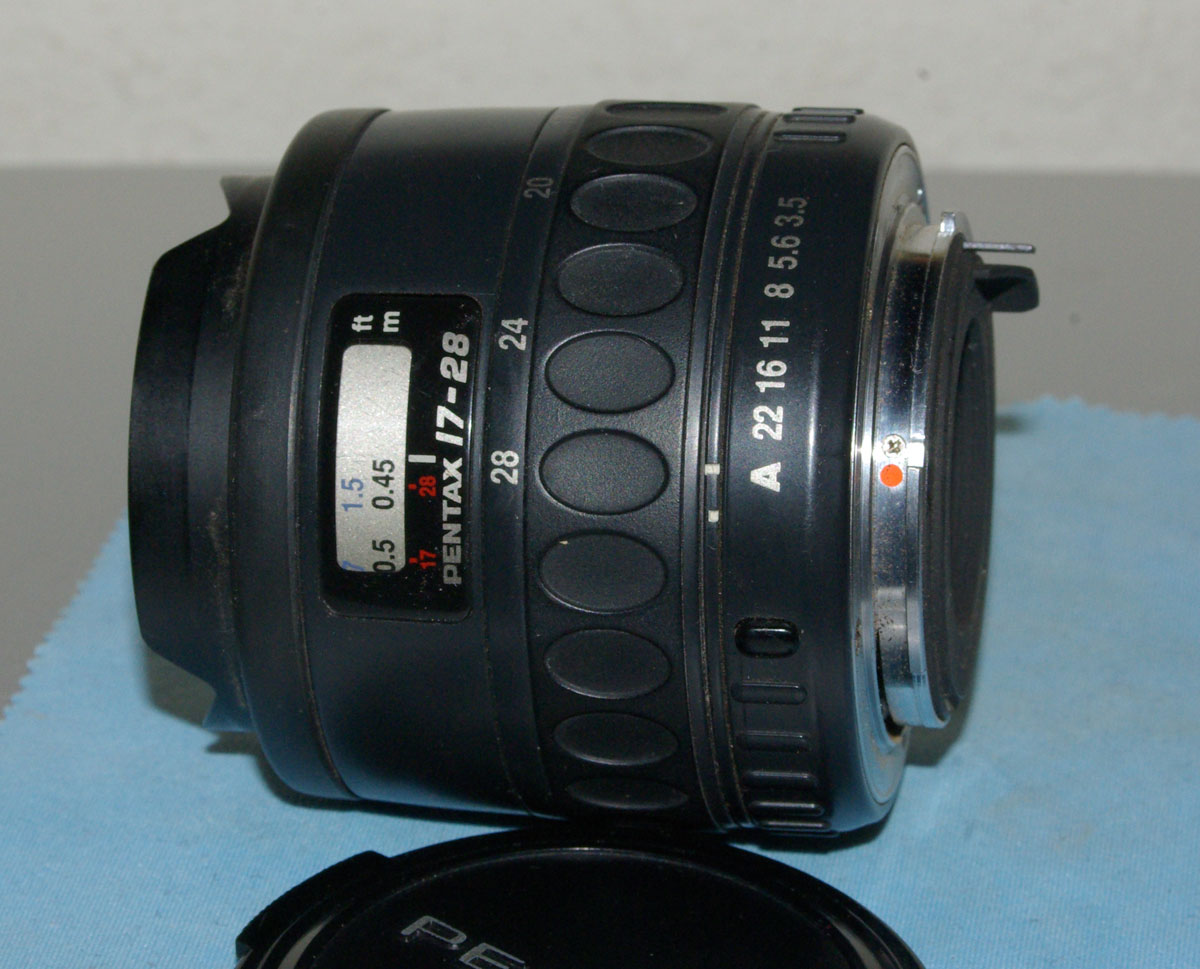
| This is a 'fish-eye zoom' on a film camera, but its mostly a zoom with a lot of distortion when used on the digital. |
|
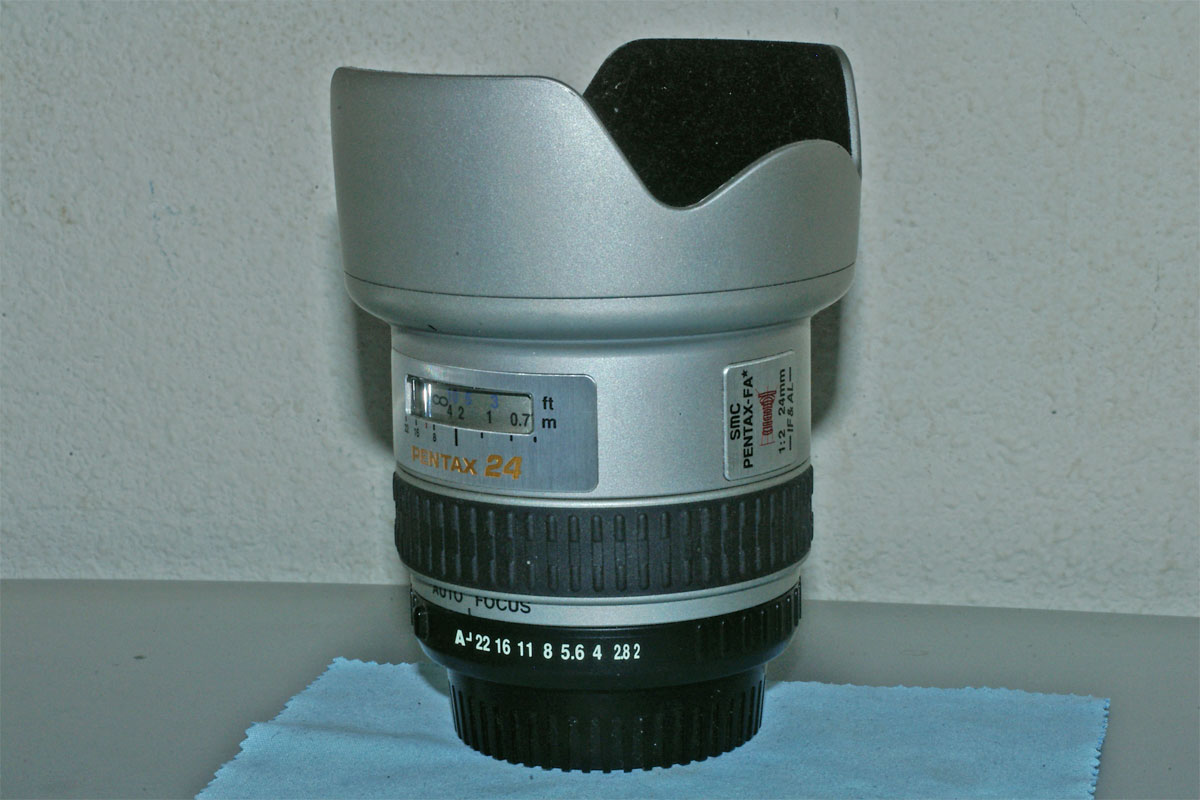
| A sought after lens with a fast F/2 speed. It's physically large but it delivers. Well to theh wide on film, a modest wide angle on digital---equilivalent to a 34mm wideangle. |
|
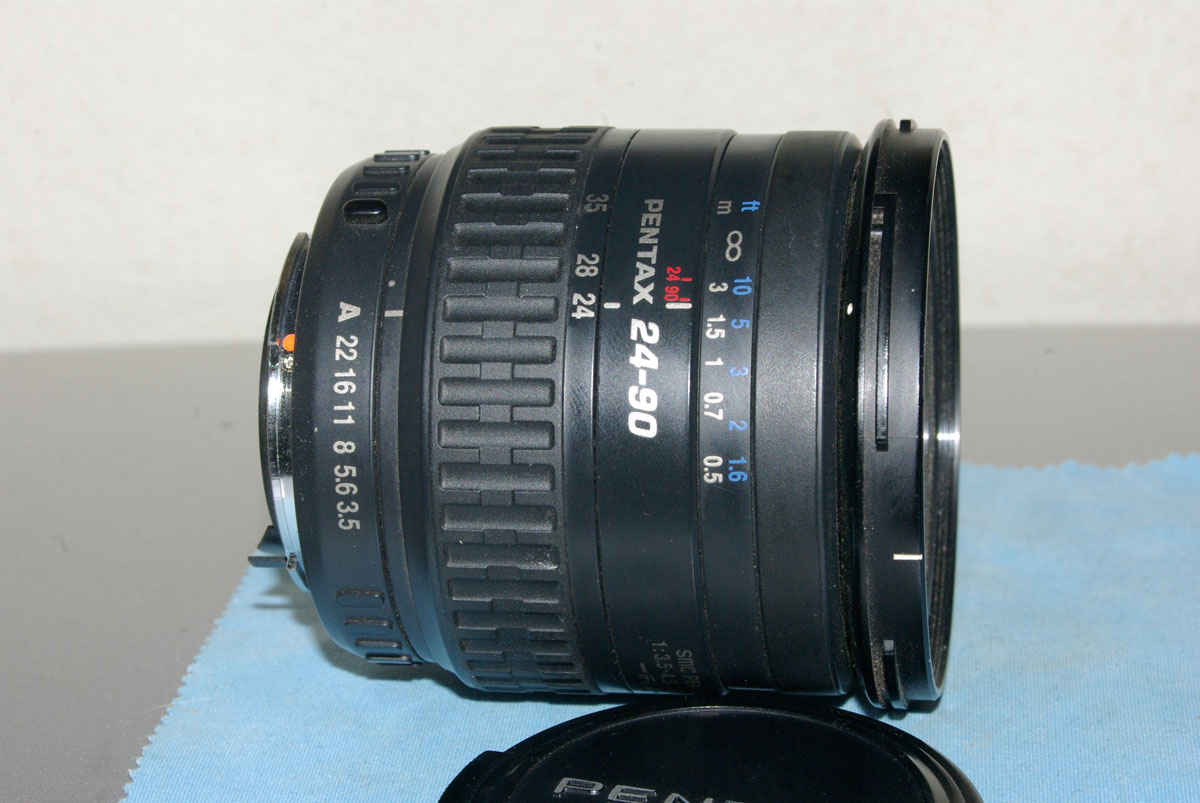
| Sort of a dream lens for film. At 24-90 f/3.5~f/4.5 if there was ever a general purpose zoom that did it all it was this lens. It certainly made all the 35-70's and 28-70's seem inadequate. It's too long for digital. |
|
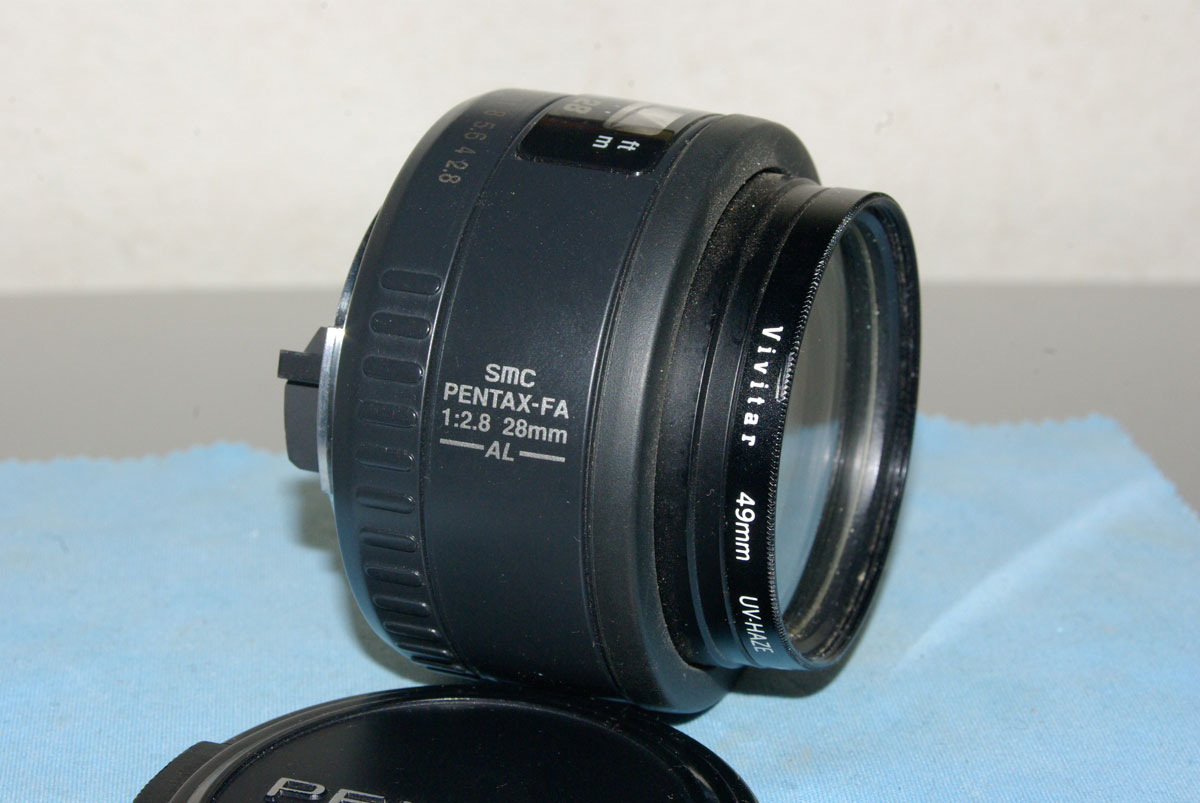
| This is the generic 28mm-F/2.8 prime. A dependable wide angle for film and boring normal for digital. The F/2.8 speed is simply nothing exotic. |

|
| In the film days, this was the one lens for all occasions except low light. As an 28-200mm f/3.8~5.6 zoom, if you could only have one lens, this was the one to take if there was plenty of light--point and shoot to the extreme. It was widely regarded as being a Tameron lens marketed with the Pentax label. A one lens solution for the masses. |
|
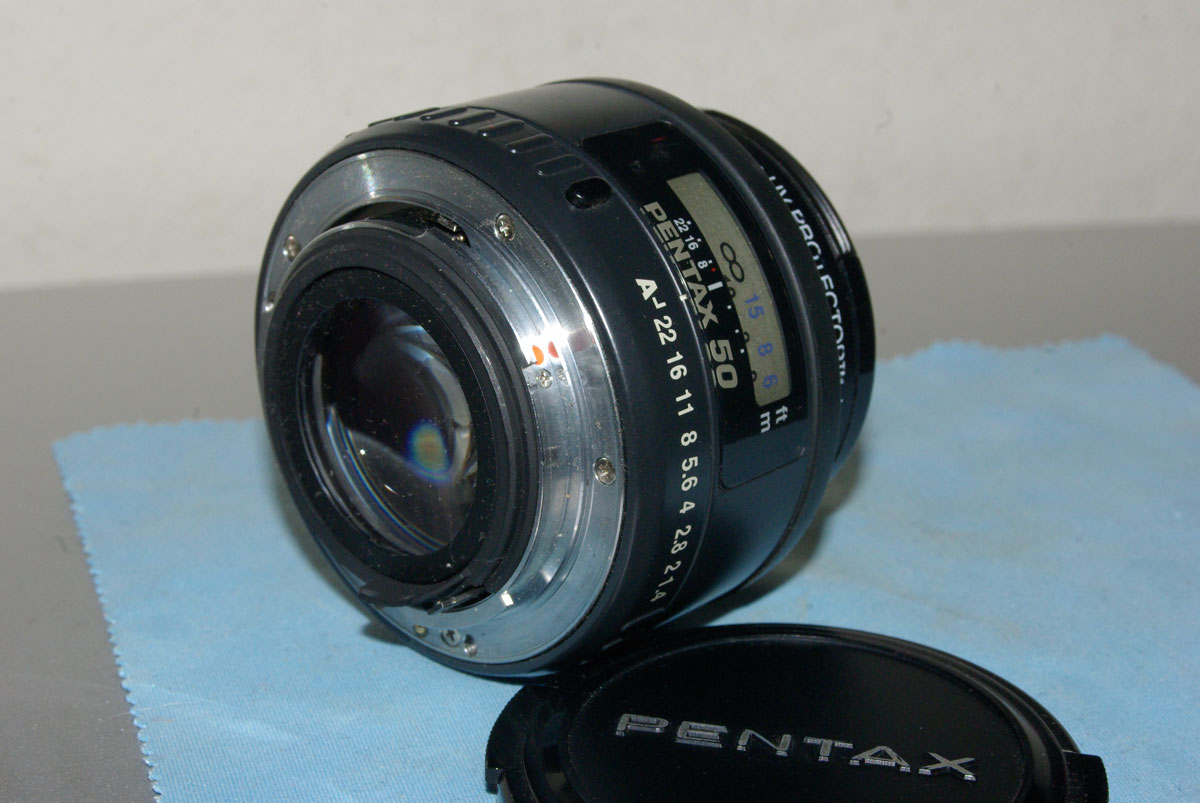
| This 50mm F/1.4 is a classic high speed prime 'normal' lens for film. It's closer to a portrait length for digital. Fast and of good quality anyway. |
|
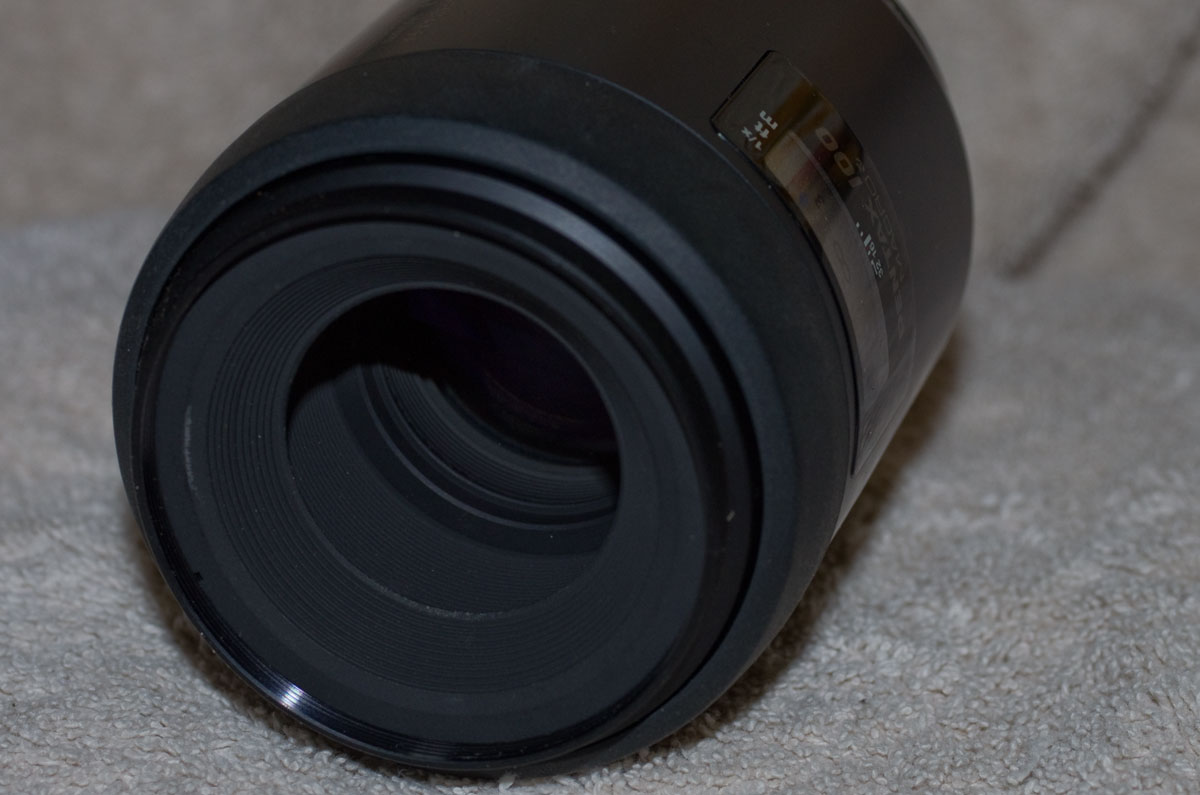
| FA 100 Macro-front view |
|
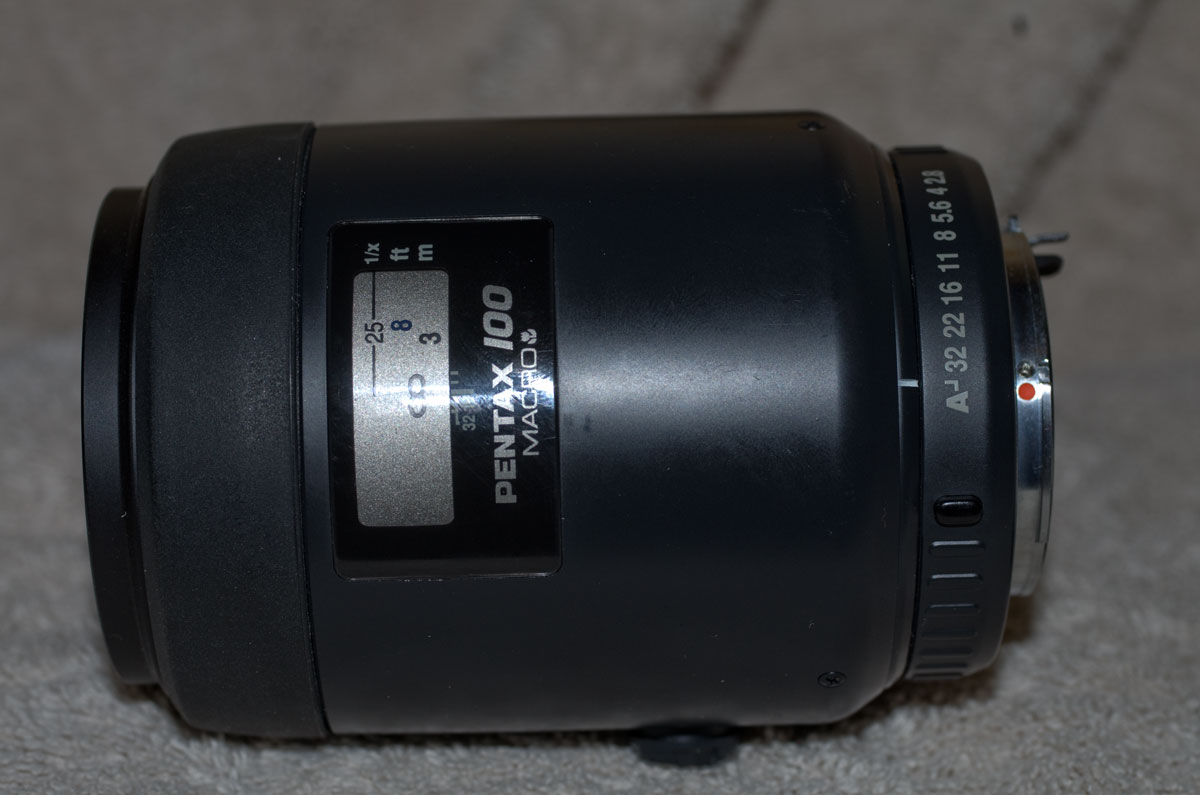
| FA 100 Macro-top |
|
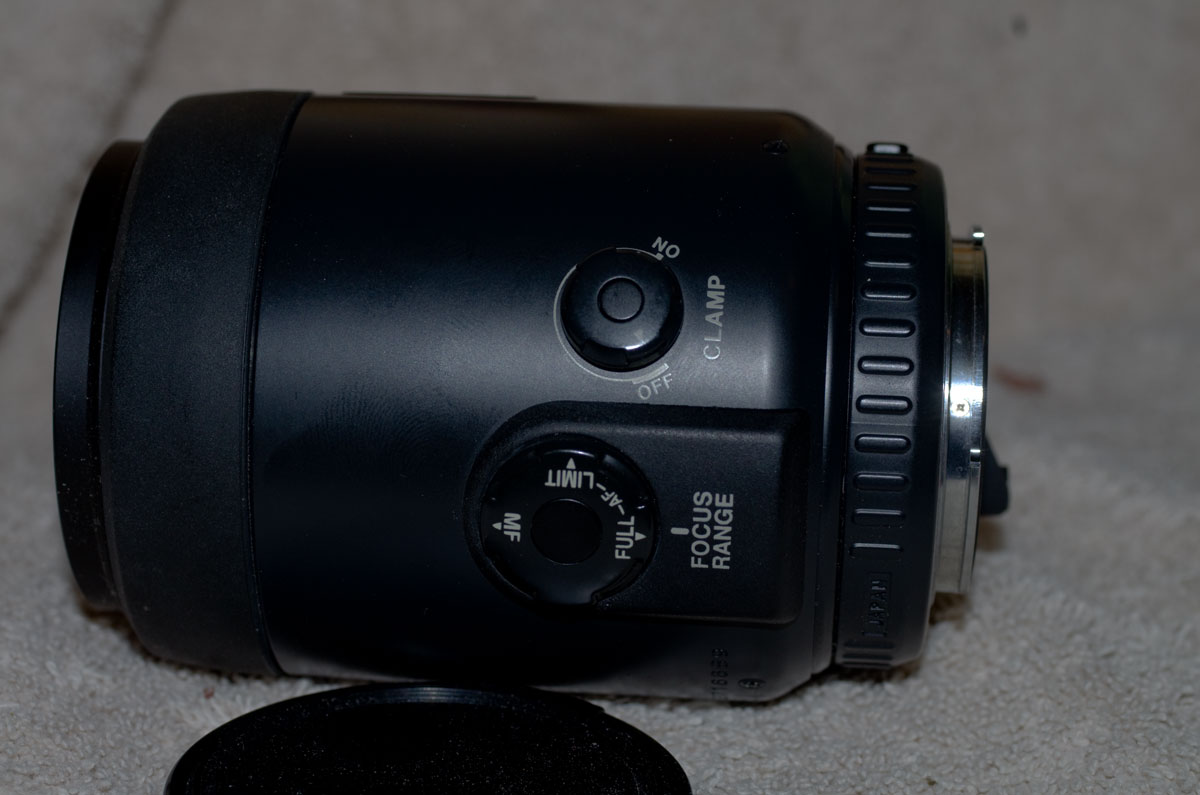
| FA 100 Macro-bottom view |

|
| FA 100 f/3.5 Macro--A low cost macro in a plastic frame. |
|
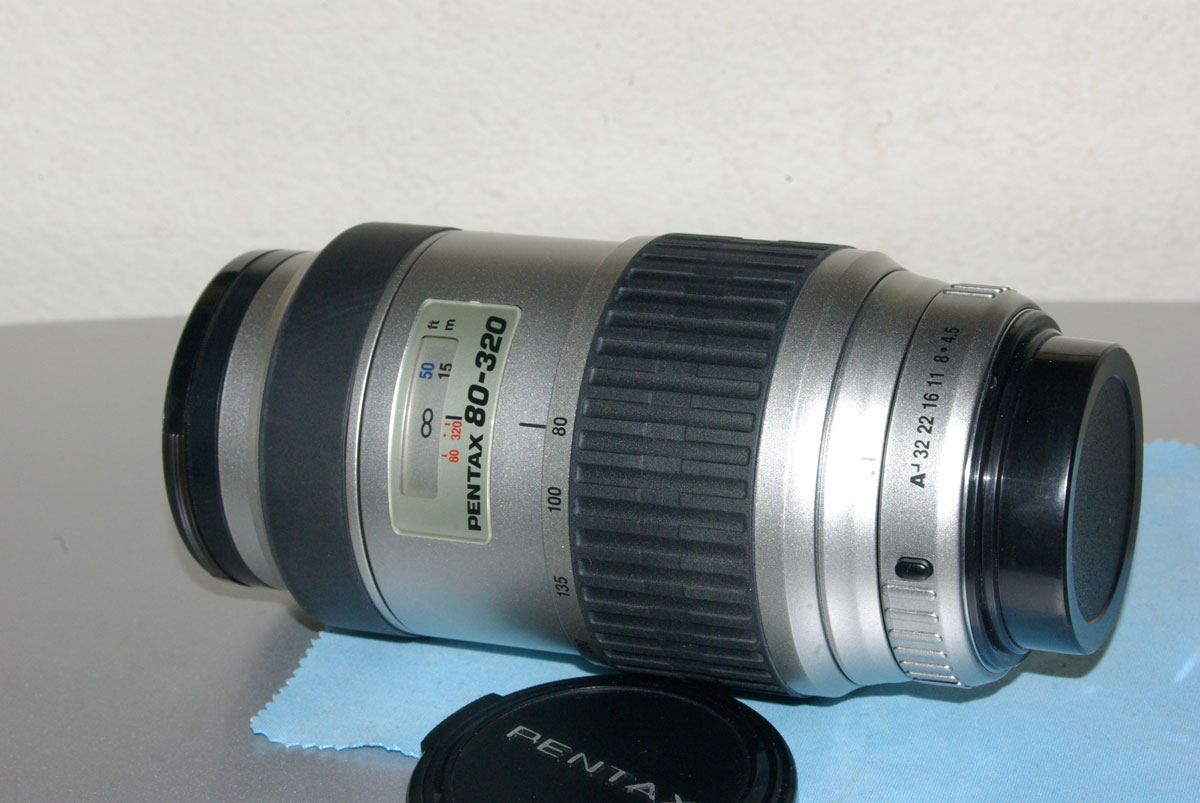
| This one is underrated. At 80-320mm F/4.5~5.6, I found it a little hard to use on film bodies. Long enough to need a tripod and with no place to put one, and so heavy compared to the body that the balance was off. On the heavier K10 Digital with shake reduction, its a low cost dream lens. With a field of view approaching 500mm equivalent with the digital format it's usable as an extreme telephoto and light and fast enough to hand hold |

|
| This is the FA 135mm f/2.8. In times past the 135mm focal length was a very popular length. Over time, however, moderate telephoto zooms have driven the popularity of this focal length down to the point that it is not currently in the Pentax lineup. This one has a metal barrel, and is similar to the FA 50 and FA 100 in physical appearance (but not size--it's much smaller than the 100mm FA macro. |

|
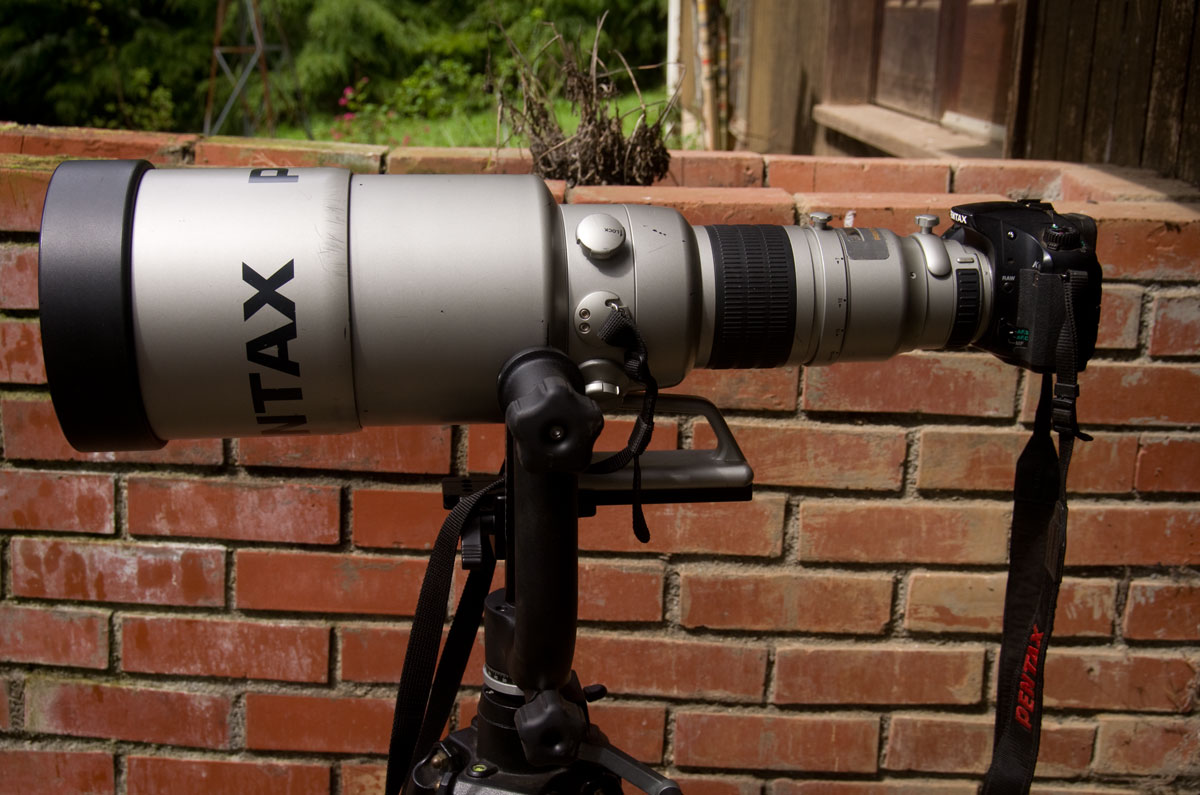
| The FA* 300mm f/2.8 is nearly 1 pound lighter than it's predecessor, the Pentax A* fatboy shown with it below. It was completely redesigned, but retains its reputation for the highest of quality. What's new, of course, is the addition of autofocus. It shares the same 112mm front filters as used on the 600mm F/5.6 and it's predecessor. Likewise it has a rear drop in filter tray, is is compatible with the Pentax Converter-A 1.4x-L and/pr 2x-L teleconverters. These converters, of course do not support the auto focus function. If hunting is an issue there is a focus limit switch on the barrel, and like the Pentax FA* 24, the focus ring is a slip ring which may be used to disengage the auto focus. |

|
| The lens hood screws on instead of being a slip out affair like the Pentax A*. |

|
|
| FA*600 f/4 |
|
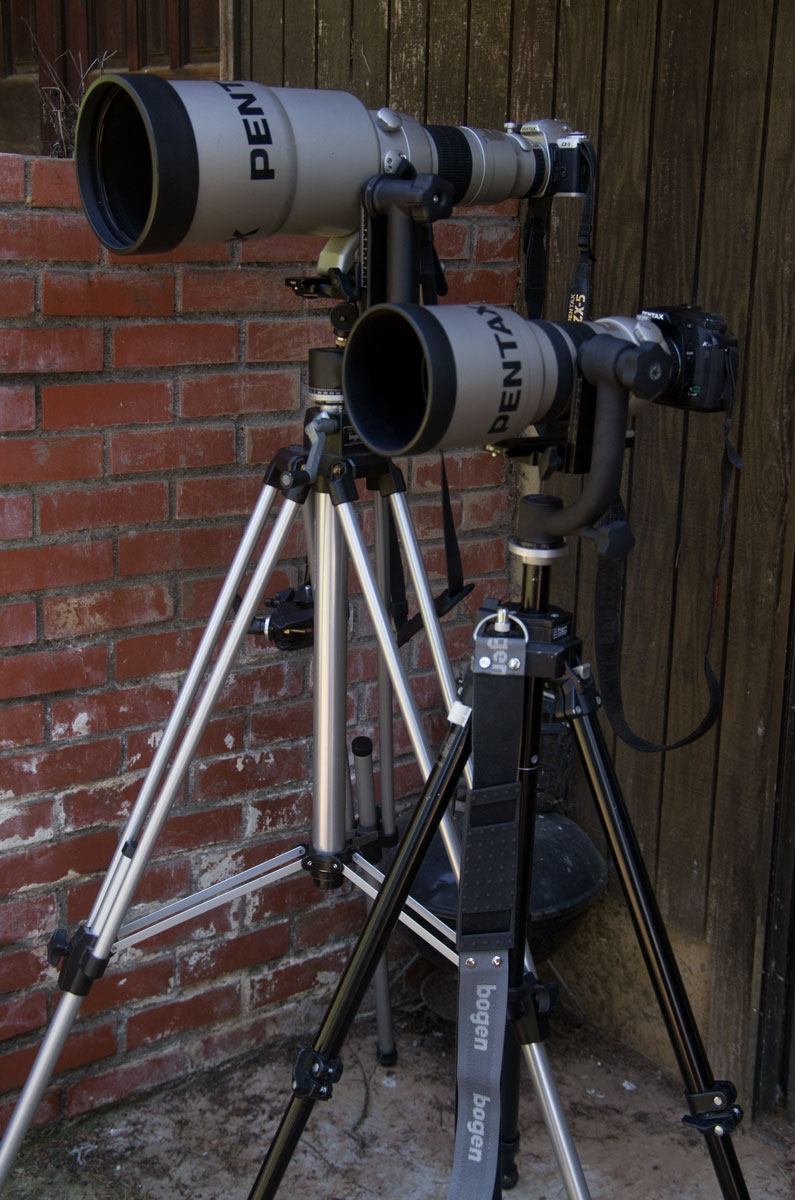
| FA*300 and FA*600 shown together |
The FA family of lenses from Pentax dominated the scene for around 15 years from 1989 to 2004. Many were added and dropped during the time. The FA replaced the briefly existing F series but were only cosmetically different in practice. It was said that the 'chip' that communicated with the camera body was different but not in a way that impacted how the lens operated or worked as as far as the user was concerned it is a distinction without a difference. The FA lenses are "Focus Automatic" in that they support auto focus. Pentax experimented with power zoom but it was not a marketing success and disappeared from the zoom lenses.

|
| Two power contacts located about 5 o'clock in the pilot bore of KAF2 mounts. |
What did not disappear was the two extra power contacts used to power the power zoom lenses. The lens mount morphed further from the KAF mount (K=original, KA=electric contacts and 'A'uto aperture, and KAF=auto focus), to the KAF2 mount. The '2' are two electric contacts on the pilot bore.
This same power contacts were later Hijacked to supply power to the lens for operation of the SDM in lens focusing. The concept of the 'power zoom' was to allow the user to zoom the lens in point and shoot fashion from a camera body switch and have an auto 'park' position. As it turned out newer lens designs tended away from the change in size while zooming in favor of internal optical adjustments which took less power, and twisting a knob on the camera body in favor of twisting a lens ring to zoom really added nothing except another way to drain the battery.
The good thing about the FA lenses is that they provide full function to the digital camera bodies, but also can be used on ANY K mount camera ever made which includes all Pentax bodies since 1975. Obviously they don't auto focus on a not autofocus body, but they will manually focus which is the feature of the pre autofocus bodies. The only thing to remember in acquiring FA lenses for a digital camera body is that the lenses may be a little bigger and heavier than they need to be because the digital foot print is APS-C not 35mm. This makes all lenses seem as they are 50% longer in focal length than they actually are. Consequently Fish eyes don't fish, and 'wide angle to telephoto lenses' tend to be 'just telephoto' This makes the '35 to nn' and '28 to nn' vastly less useful as a single all purpose lens on digital bodies than they were on film bodies.
Over all the 'prime lenses' (Non zoom), and the 'long zooms' are the ones that migrate to digital bodies the best although the all 'work' from a mechanical standpoint.
Near the bottom of the list you will find 3 views of the FA100 Macro f/2.8. It's interesting all the way around becasue of its design. On the front you will notice that the optics are deeply recessed. This is because the barrel has to be quite long to provide the travel to get down two a 1 to 1 ratio at this focal length... Also of interest are the clamping and focus limiting buttons. The clamping adds some drag to the focus rotation, while the limiting button does just that, and when set it limits the range that the auto focus visits in finding its happy home.
Following it is a low cost Pentax 100 f/3.5. "Low Cost" or "Consumer model" are the operative words here. It is on a plastic frame, is slower, and has none of the hunting limiting buttons. It will never be seen on a list of 'most adored' for quality lenses, but there is a place for close ups on a budget and it isn't 'that bad'.
With the acceptance of the autofocus as an industry standard, Pentax still dallied and did not universally embrace autofocus. In the limited production exotic lenses many were never produced with an autofocus version and the manual focus versions continued to be offered. Given that the dedicated converters for these lenses were not auto focus, it is not surprising, as paying a lot extra for an autofocus lens only to disable the autofocus feature with a converter didn't make a lot of sense.
Pentax did however produce the most popular extreme telephotos in an FA configuration. They sold an FA 300mm f/2.8 which was of an entirely different design that the Pentax-A 300 mm f/2.8. They also produced a well regarded FA 600 f/4 which is something special in anyone's book which replaced the Pentax-A 600mm f/5.6. Sadly none of the exotics are in production now.
Shown next to last, but not least, is the FA* 300mm f/2.8 (mfg: 1994-2004)followed by the FA*600 F4( mfg: 1991-2004). Pentax also made a more popular FA* 300 f/4.5 which was much more affordable. Unfortunately, Pentax never produced a teleconverter designed to support the autofocus features of their lens family. The closest is the Adapter-F described on another page. An F/2.8 extreme telephoto is just one of those lenses that screams out, "put a converter on me." The Converter-A 1.4x-L and 2x-L are compatible with the FA 300 f/2.8, but alas do not support the auto focus feature. Likewise, the FA*600 performs well with these dedicated converters.
FA* 600 F/4
Pentax was most aggressive in the market place during the late 1980's and 1990's. They marketed a full line of lenses including numerous extreme telephoto lenses. While they were made to order, there are quite a number of them around. the "*" in the model names is suppose to signify the special high class lens (and usually does). Before Auto Focus became the norm, Pentax produced the "A" series lenses which morphed briefly to the "F" series and then to the 'FA' series. Not all of the extreme telephotos of the "A" series made it to the autofocus models. The less common A*400 f/2.8, and the A* 1200 f/8 configurations did not appear as auto focus models. Redesigned variants of the 300f/2.8 and a 600mm did appear as FA* models. The 600 became an f/4 lens and a heavy weight champion. As you can see from the joint photo, the FA 300 and FA 600 shasre common styling. the lens hoods are different however. The hood on the 300 is removable and is attached by screwing it on and for storage is removed and reversed and will screw on backwards. On the FA*600 the hood is a sliding hood that is non removable, but instead of having a set screw to hold it as was common with the A* longs, or flopping around as with the less expensive models on the FA*600 the hood has a set of threads on each end and will screw into position retracted or extended. Very Unique.
FA* 250-600 f5.6 Zoom
I've never seen one of these, but some of them exist. I have no idea how many of them were sold, but I suspect that they were not as big a seller as were the primes. I mostly only mention lenses with which I've ahd actual experience, but somehow this one deserves mention just because..... It's considerably lighter than the 600 F4 and has physical appearance (from photos I've seen) more like the A*600 f/5.6.