Pentax F Auto Focus Lenses

|
| Pentax has made a great number of variants of this lens. It straddles the 'normal' 50mm focal length and throws in some macro capability. With digital photography effectively changing the 'normal' range to around 32mm instead of 50mm, these lenses are really cheap on Ebay. They are very uninteresting. I prefer to call them 'close focusing' instead of Macro, but they surelyl are a poor mans macro lens. I think I paid something like $16 for this lens. |
| All photos with blue borders expand if clicked |
|
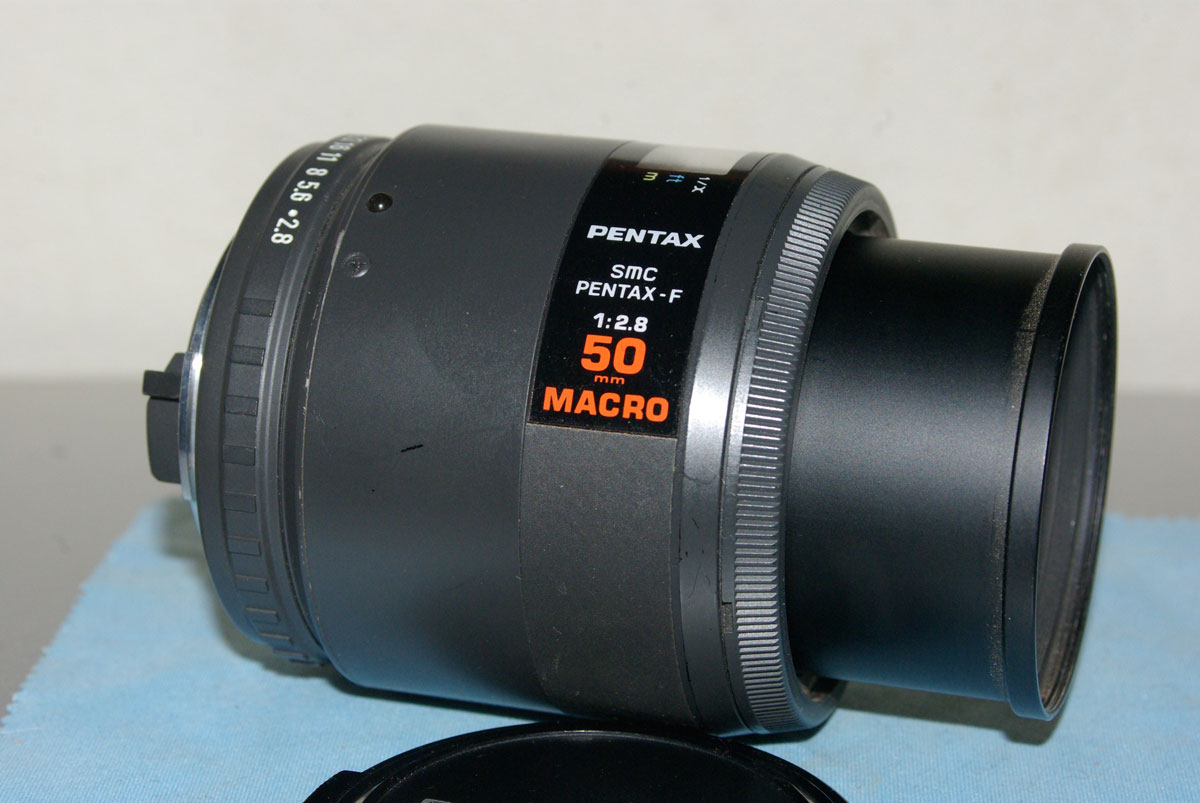
| On the other hand, this lens is worth plenty. A 50 mm macro, it is optically identical to the newer FA model. The optical quality is excellent and it focuses down to a 1:1 ratio on film, implying that if you get close enough the size of the object in real life and the size of the object on the negative will be the same. Lighting is the difficult issue, as the camera lens is less than 2" from the subject at this magnification. The introduction of this lens ended the need for bellow and extension tubes for the most part. Before this lens came out macro lenses often only were 1:2 in magnification and you needed tubes to finish the job, but this puppy does it all. |

|
| Pentax has made a large number of zooms that straddle the 50mm focal length which was 'normal' for 35mm film cameras. Some start as 28mm on the wide end while others start at 35mm and have various maximum focal lengths. Most are 70 or 80mm but some are 135mm. This is one of the less common and longer range models. As with the 35-70 on the top of this list, it has a 'close focusing' mode. |
|
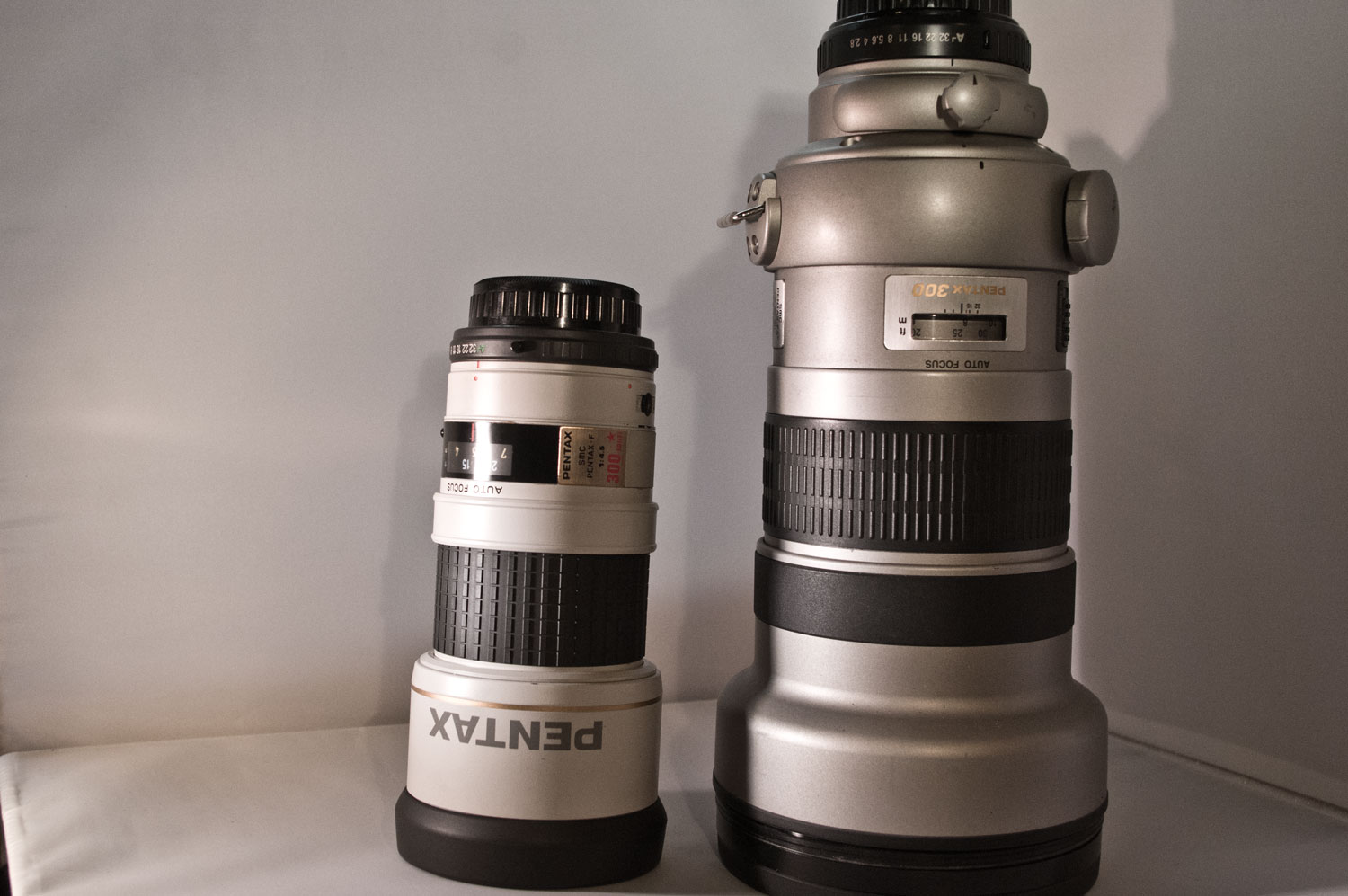
| F* 300 F/4.5 While, I've tended to be a little critical of the F series of lenses, one worthy and widely acclaimed is the F*-300. Pentax has long used the "*" in a model name of a lens to denote especially high quality, and the F*-300 is certainly worthy of the designation. It is close to the world's lightest 300mm lens for SLR cameras, and despite its small size and light weight, its optical quality is outstanding. It only sacrificed some speed to get smaller than than the others such as the FA-300 f/2.8 shown on the right of the photo. |
The last half of the 1980's were very dark days for Pentax in my opinion. Although Pentax first introduced an ME-F in 1981, that was a modified ME with a focusing motor in the lens it was not a marketing success. With the failure of the ME-F, Pentax went on to produce the KA line of lenses beginning in 1983 and 1984 which enabled the 'Super Program' model with programmed metering.
However, in 1985 Minolta shocked the camera tree with an autofocus system that both worked and was commercially successful. This apparently caught the rest of the industry flatfooted. Canon, Nikon and Pentax spent 2 years responding and in late 1987 and 1988 produced auto-focus camera bodies. This required a new lens set. Canon produced a completely new mount incompatible with the previous mount they had used, while Nikon and Pentax used backwards compatible modifications.
Canon put the focusing motor in the lens, while Nikon and Pentax drove the focusing from a motor in the camera body. It also required major re-engineering of both the camera and the lens set. Besides the technical difference of a 'drive shaft' through the mount to turn the lens and one additional electrical contact for data transmission, the lenses to minimize the need for horsepower to focus them needed to change from heavy rotating parts which could be turned by hand, to light internal parts which moved as little as possible and as fast as possible. Pentax called these lenses IF (Internal Focus) lenses. They usually have a ring somewhere you can turn manually, but they are difficult to hand focus compared to the old helicoids that were fairly stiff and turned a lot from one end to the other.
The really big deal for the camera side of things was the need to add a large battery. The Super Program and functioned just fine with a couple small button batteries as all they did was power the light meter and release the shutter, but suddenly the camera needed high power motor that could crank the focus back and forth. Cameras suddenly got big and ugly. In 1987 Pentax produced the SF series of camera bodies with autofocus that were very plastic looking, bulky and expensive, but continued to offer the manual focus products.

|
| Drive shaft (on right) connection in F (and later) lens mount |
Mechanically, the F (and later FA and DA) style lenses are focused with a motor in the camera body which connects with a drive shaft through the lens mount. The photo here shows the back of the lens. When the lens is mounted and locked into position, it aligns with a keyed shaft on the front of the camera body. This shaft necessarily turns fairly rapidly to focus the lens which accounts for the whirring noise associated with focusing this type of lens.
The Pentax-F lenses were produced from 1987 to 1991 and then phased out in favor of the Pentax FA series that was discontinued in 2004. Many of the FA lenses are repackaged F lenses. There is no functional difference between the F and FA lenses as far as the user is concerned. The differences are cosmetic (no garish red/orange lettering) and reportedly in the chip that transmits the lens secrets to the camera body. However, there is a functional difference that sets the FA Limited lenses apart from the generic FA and F series lenses. Specifically, the FA Limited lenses and (as well as DA models) transmit lens correction information to the camera body which at least in the K5 body can be processed to correct certain optical distortions characteristic of the particular lens.
F*300 f/4.5 is outstanding
An astonishing example of a really good lens with the F series is the F*300 f/4.5. This lens produces a lot of outstanding photos. While it is not compatible with the contemporary (with it) 1.4x-L converters, it works grandly with the HD Pentax DA-1.4x Aw converter providing a light weight, easily hand-holdable combination. Personally this writer and tended to the fast, heavy and expensive glass such as the FA300 f/2.8 shown on the right for comparison's sake, but the latter needs a tripod and this one doesn't. and that is a big deal if you are after birds in flight or other scenes that don't hang around while you set up equipment. You will obviously need good lighting for this lens, but 'good lighting' means a lot less than it did in the film days. After all, it wasn't that long ago that Hi-speed Ektachrome was rated at 160ISO (ASA) and now I don't hestiate to turn the K3 up to 9600 ISO if need be.
'A' series lenses do not have accurate metadata
One thing you will notice if you use the 'A' series lenses on the digital cameras is that your photos will not have accurate 'metadata' about the focal length and other lens data of the lens used for the photo, because the camera simply doesn't know that information. The reason is that the earlier lenses do not have the 'data connection' which was added to the K mount along with the autofocus drive shaft. The data connection provides the camera body with various data parameters about the lens and at least in the later SDM style lenses interactively provides the data path to control the focusing operation.
I didn't indulge in the ugly plastics of the era, and the only three "F" lenses that have crossed my desk are a ones I bought on EBAY well after they weren't made anymore.
In recent digital models, however, you will find the opportunity to input the focal length to facilitate the function of the shake reduction. This will, not however, specifically identify the lens, nor will it be necessarily 'correct' in that if for example the lens is a zoom, entry of a number when you mount the lens won't anticipate the focal length at which the lens will be used.
Perhaps of less significance, even the F and FA series (excepting) the "limited" models do not provide information to the carmera to implement 'optical correction', a feature that is supported by the DA series lenses. The "Limited" series consisting of 4 lenses wasn't intoduced until after the F series was discontinued. Over all there is not any reason to think differently of the F and FA series. Where there are equivalents they usually have the same optics with the difference being cosmetics. In one instance the F lens is to be preferred. In this case the 300mm f/4.5 F series has a tripod mount while the optically identical FA version does not.
It is worthy of note that the F* 300 was sold new with a bolt on tripod mount. It seems, however, that most have been unbolted and discarded over the years, and it is the exception to find one of these lenses on the market with the tripod mount included. Later when Pentax introduced the FA series, they made an FA 300 that was optically identical, but a little heavier and which did not include provision for a tripod mount