Pentax Photography System Circa 1984
| All photos with blue borders expand if clicked |

|
| Pentax Super Program -- The first A Body |

|
| Pentax SMC-A 3.5 15mm A very unique lens. In the film days this non-fisheye was regarded as an extreme wide angle, although not profoundly wide with a digital crop, it's a bit of a collectors item, these days commanding a fairly substantial price on the second hand market. |

|
| Pentax SMC-A 24-50mm -- Extra wide to Normal. This F4 lens was one of my favorites in the days of using the Super Program. If bad lighting didn't force the use of a fast prime, this was a very good 'walk around' lens. Many photographers used a 35mm lens for 'walk around' and this was an alternative with reasonable zoom in both directions from the 35mm base. |
|
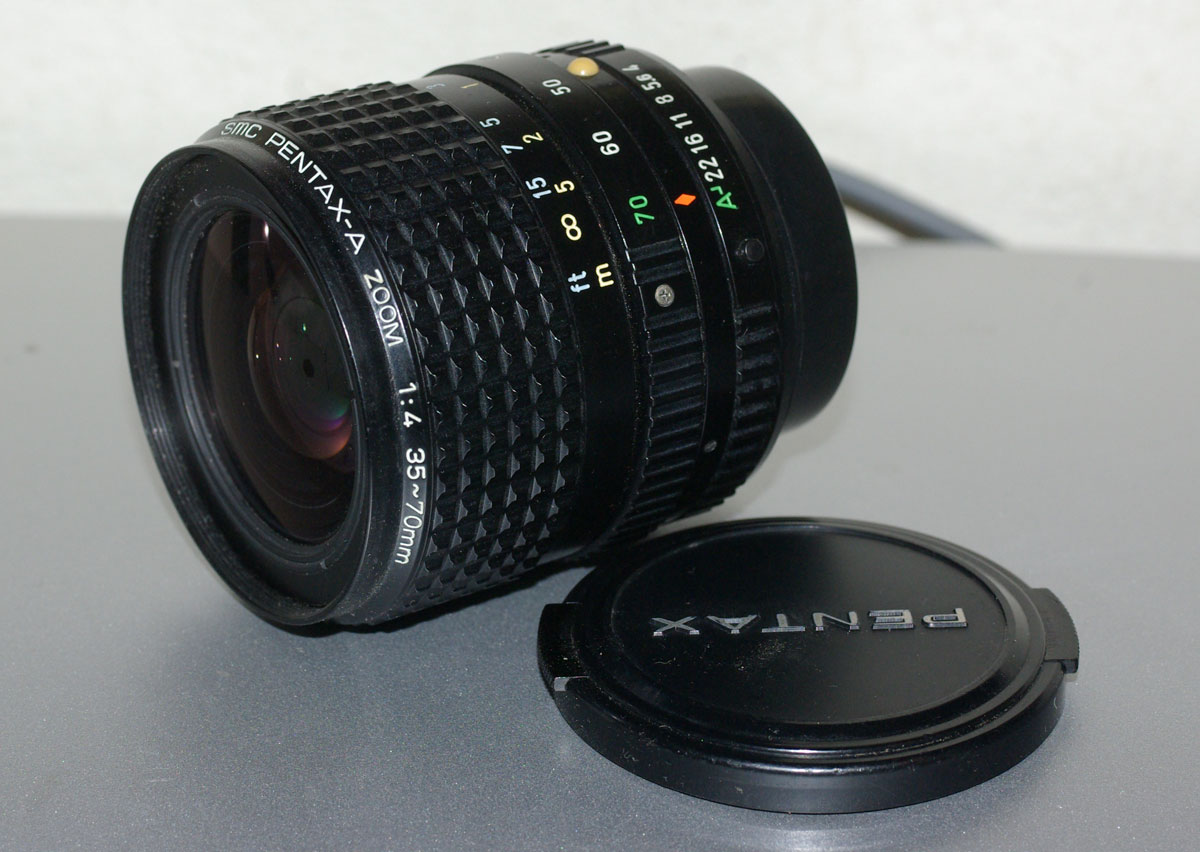
| Pentax SMC-A 35-70 Wide to long with close focusing. To me less useful than the 25-50, but Pentax has produced many variations of the 28 to xx and 35 to xx zooms for those who liked a 50 mm 'normal' lens. Lenses of this variety---bracketing 50mm really became useless with the advent of the half frame (digital crop) digital cameras that made all focal lengths effectively longer. |
|
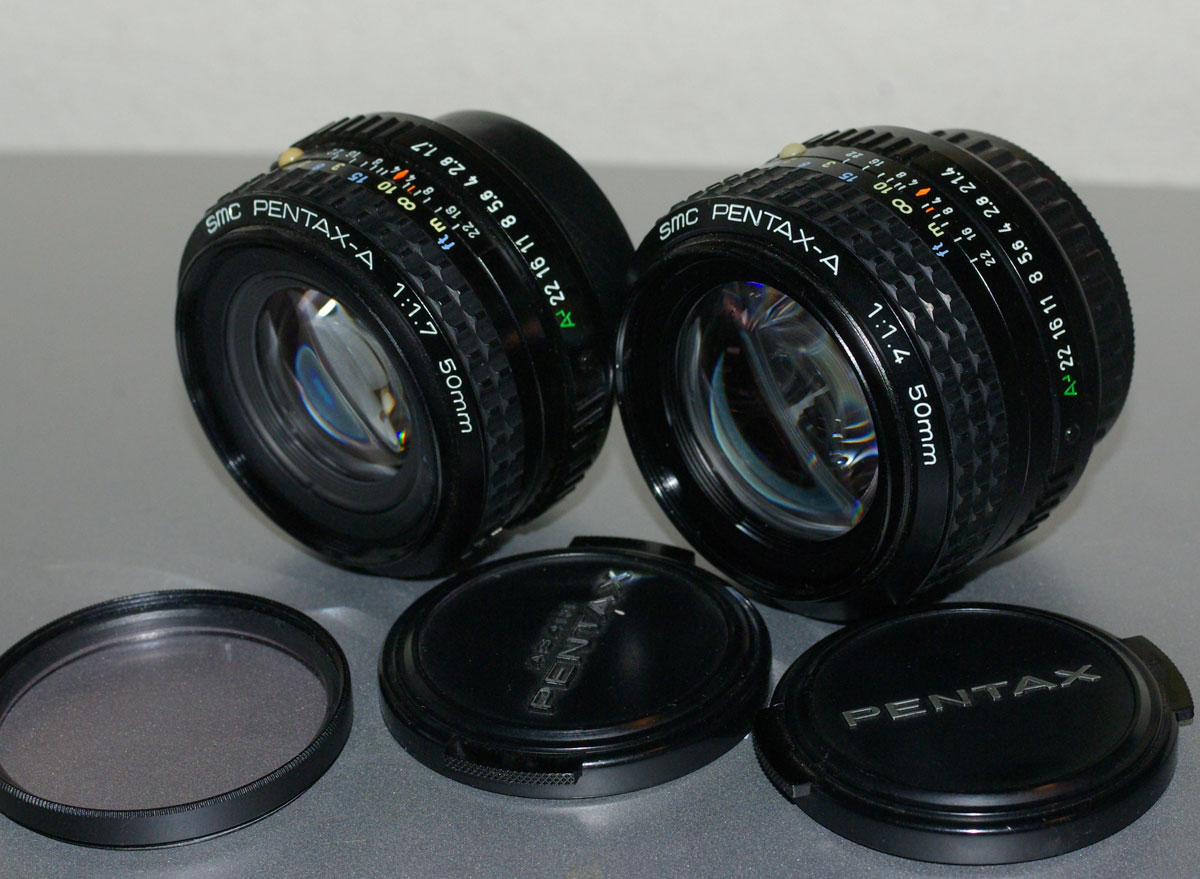
| F/1.7 and F1.4 50mm Normal lenses. Pentax offered 4 different primes as classic 'normal lenses'. They were similar in appearance but had different speeds. Low end cameras (typically the K1000) were bundled with an F/2 lens, while the upline cameras had the F/1.7 model standard, and the F/1.4 for modestly upscale. More talked about than sold was the 1/2 stop faster F/1.2 lens. This latter lens disappeared with the evolution of the lens mount to the FA design,and there may be questions as to whether the FA style lens of a f/1.2 speed could be made is unknown to this writer although the KA f/1.2 work in the KAF and later bodies. |
|
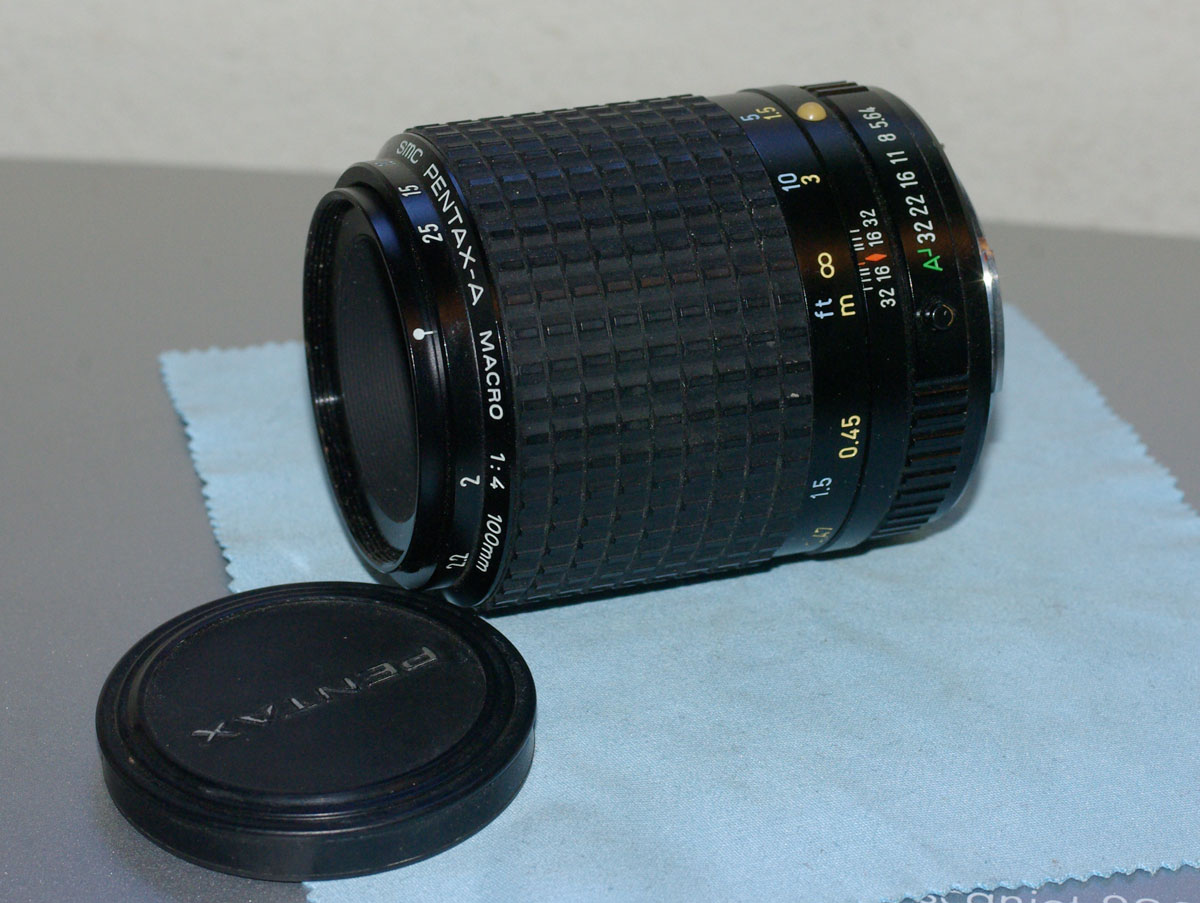
| SMC-A 100mm Macro F/4.0. This is a well respected optic, however it does not extend to a 1.1 magnification thus requiring extension tubes to 'get there'. The newer macros (FA/DA) have a longer barrel and do not need extension tubes to achieve 1.1. |
|
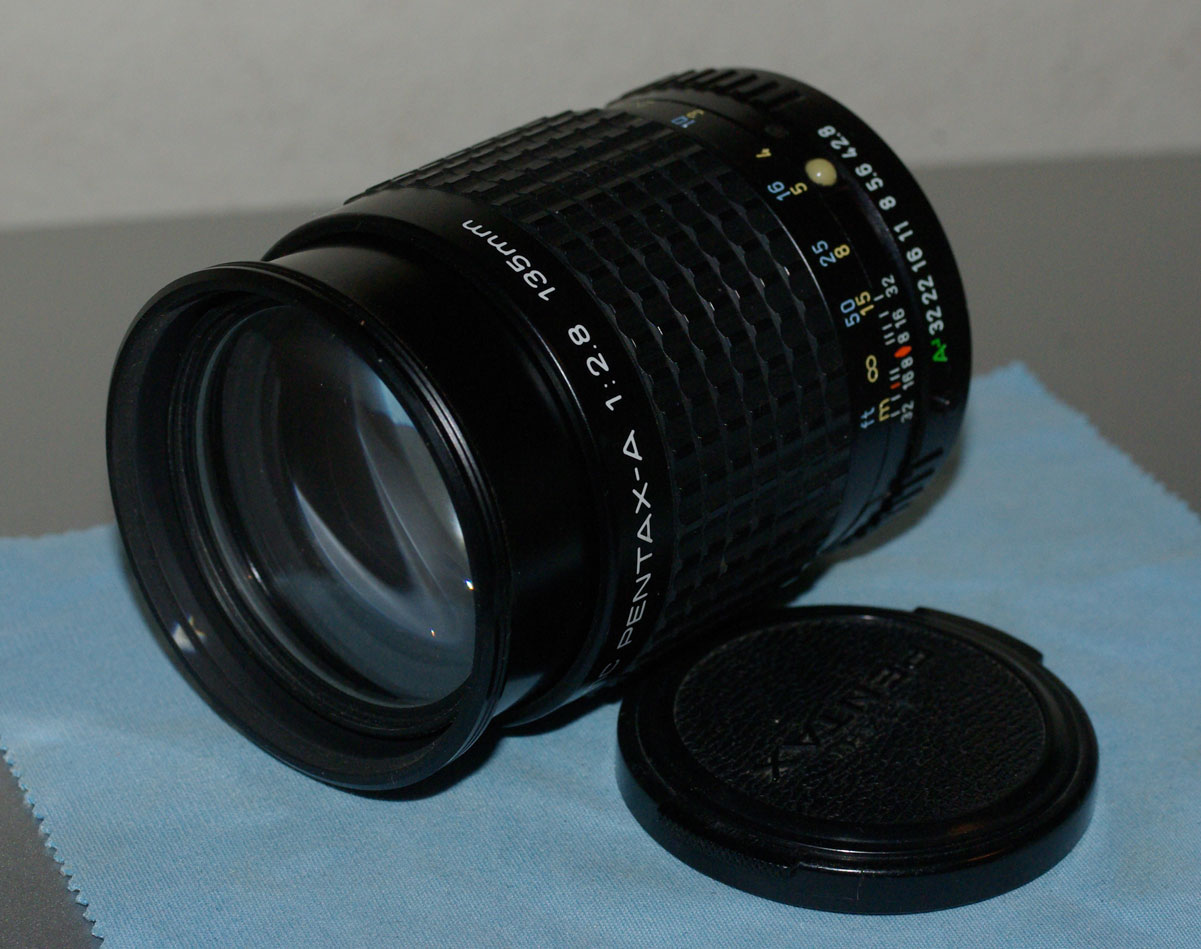
| SMC-A 135mm f/2.8 Telephoto -- A traditional moderate telephoto. I don't know what else to say, This is a classic prime that fell victim to the ever increasing popularity of zooms in this range such as the 80 to 200 zoom. |
|
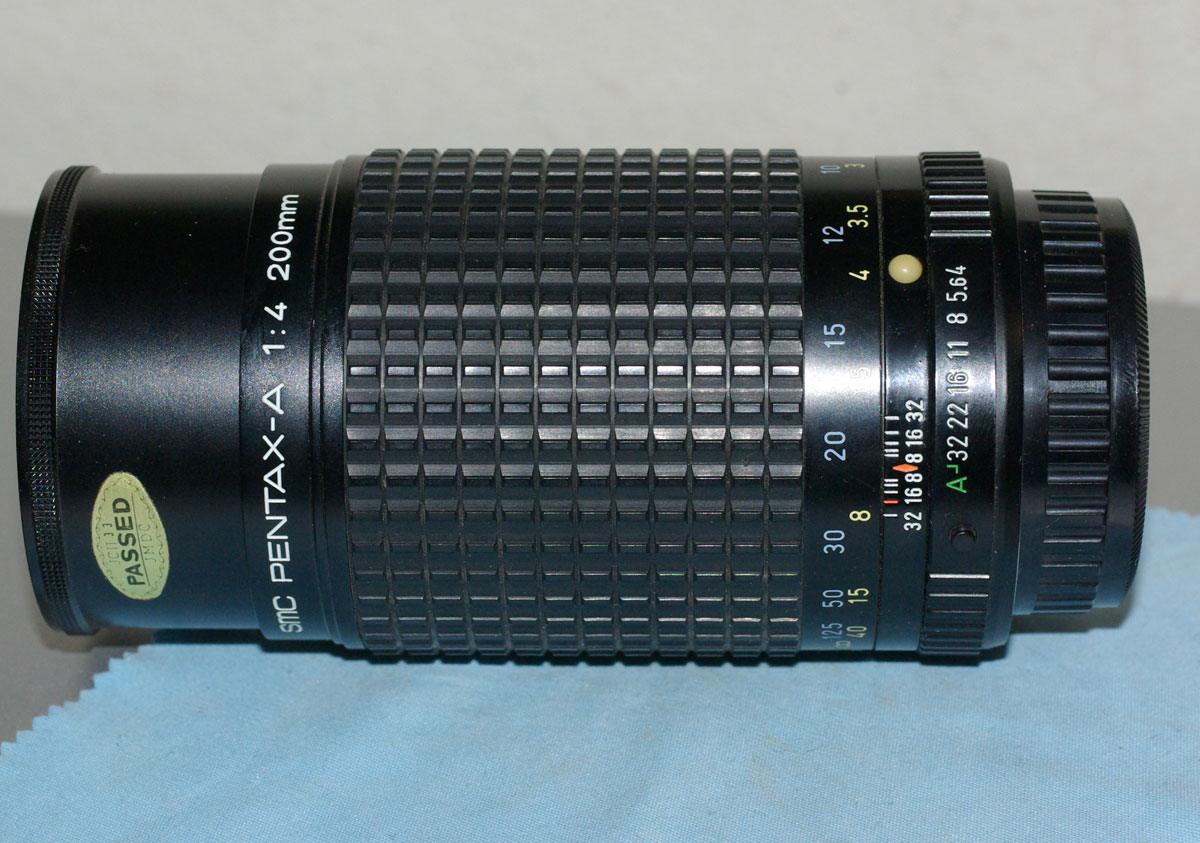
| SMC-A 200mm F4 -- Beginning of the Extreme telephoto range. This is a focal length that remains in demand for long sports shots and large indoor events. |
|
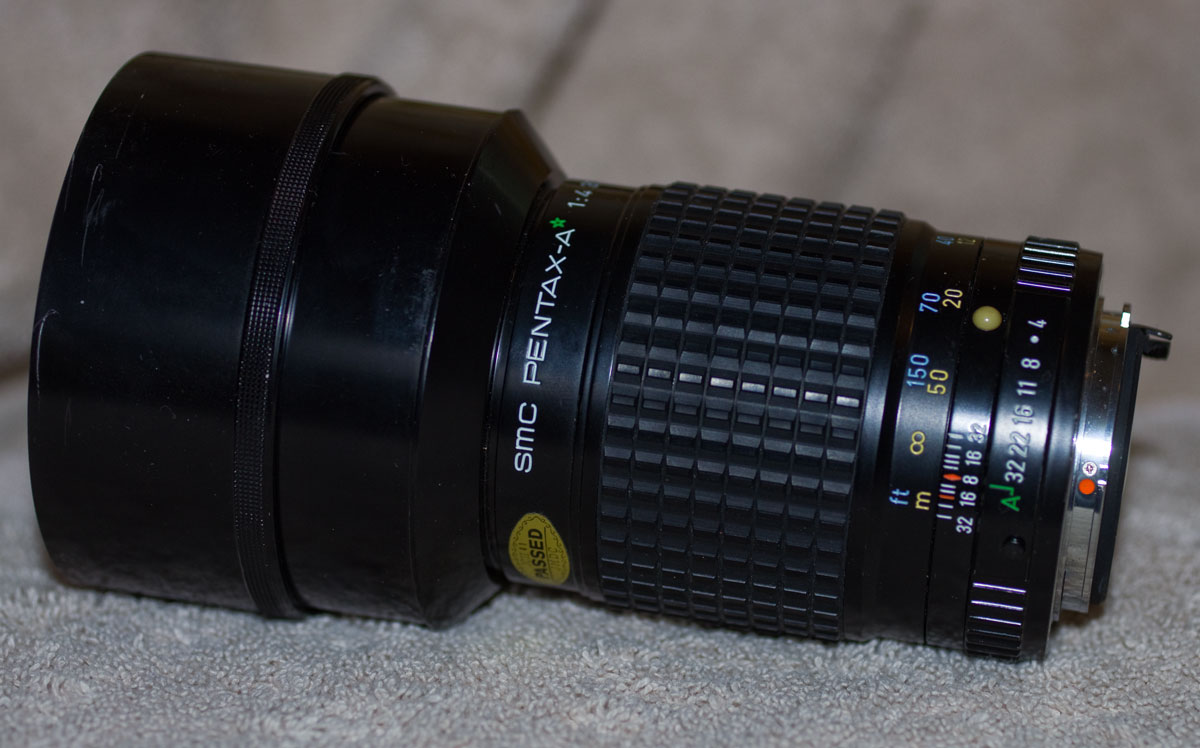
| Pentax A* 300mm F/4 Extreme Telephoto. This lens was produced from 1984 to 1989, and was a rework of the Pentax M* first produced in 1981. differing only in having a KA mount instead of a K mount. It is a high quality lens but is not compatible with the "dash L" long converters because it's rear element will conflict with the protruding element of the "Dash L" converters. Very compact in size, this lens is only slightly longer than the 200 mm F/4 |
|
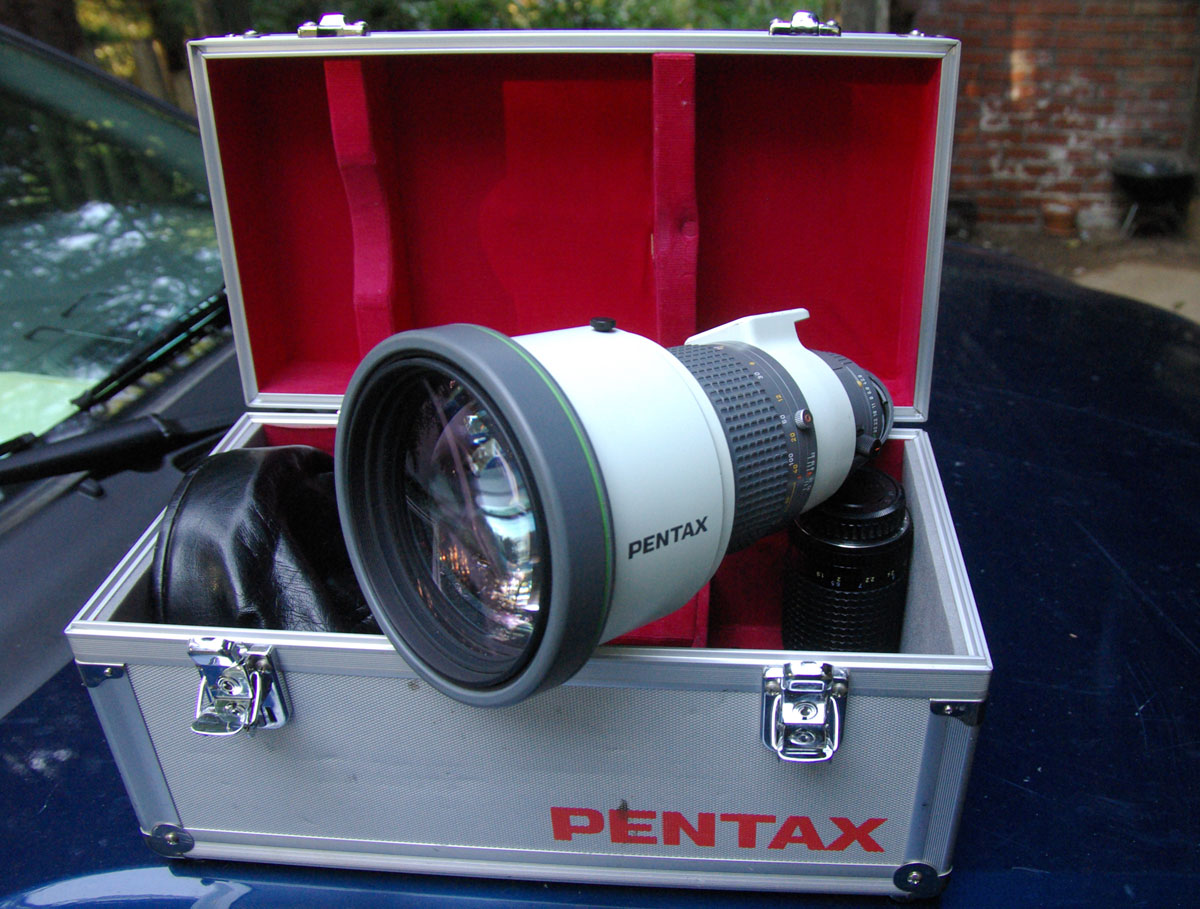
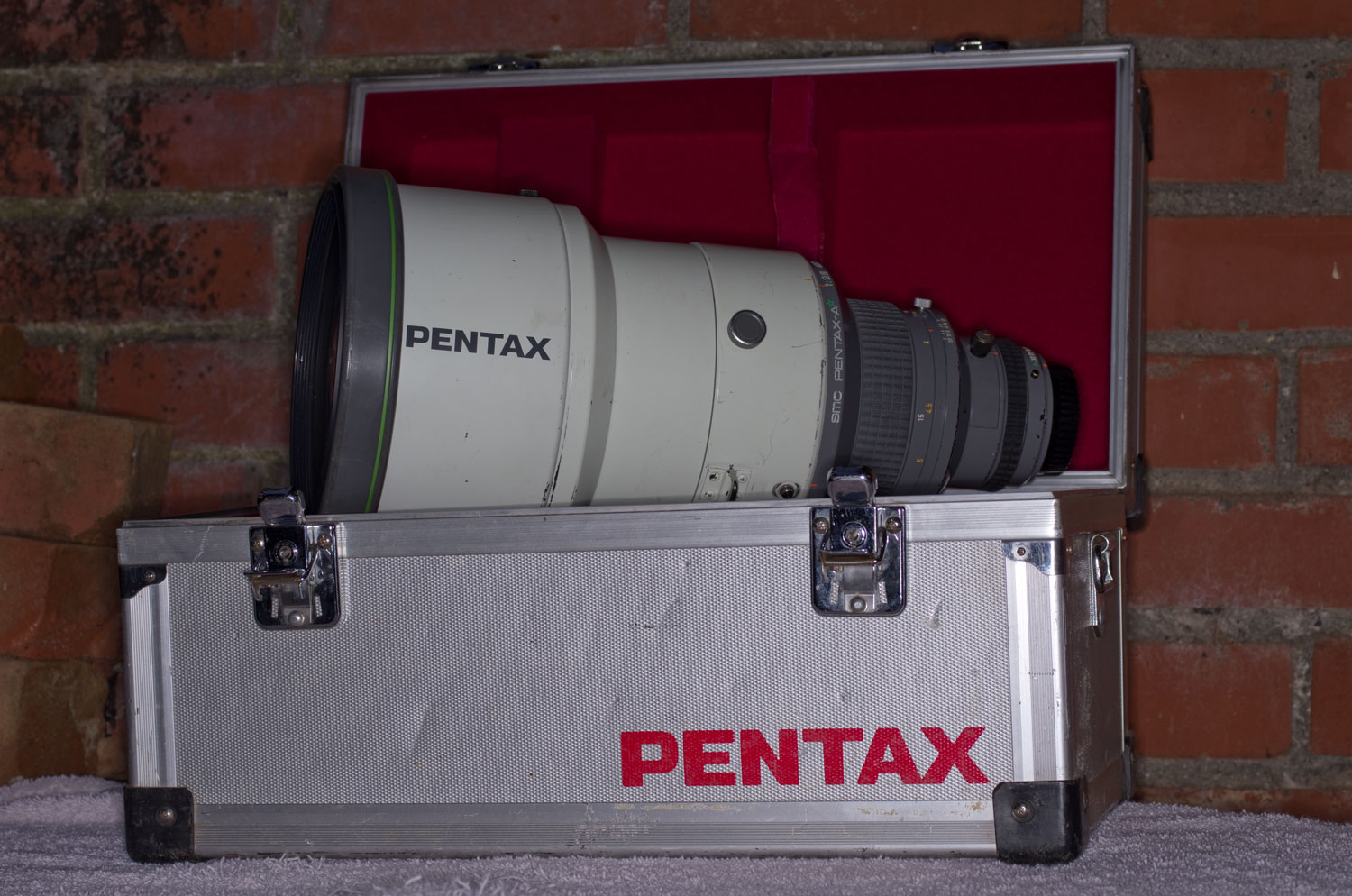
| Pentax A* 300mm F/2.8 Extreme Telephoto. Also introduced in 1984, but produced on special order at least until 1997, this is a classic Pentax extraordinary lens. This lens was sold in a dedicated trunk for several thousand dollars. Matched with it were the special "Long converters", and the high speed of this lens particularly invited use with a converter. There are today many lenses including fairly inexpensive zooms that will work to 300 mm but the thing that this lens has that the others don't is that it is the foundation for a converter to provide a useful combination up to the 600 mm range while retaining a reasonable speed. |
|
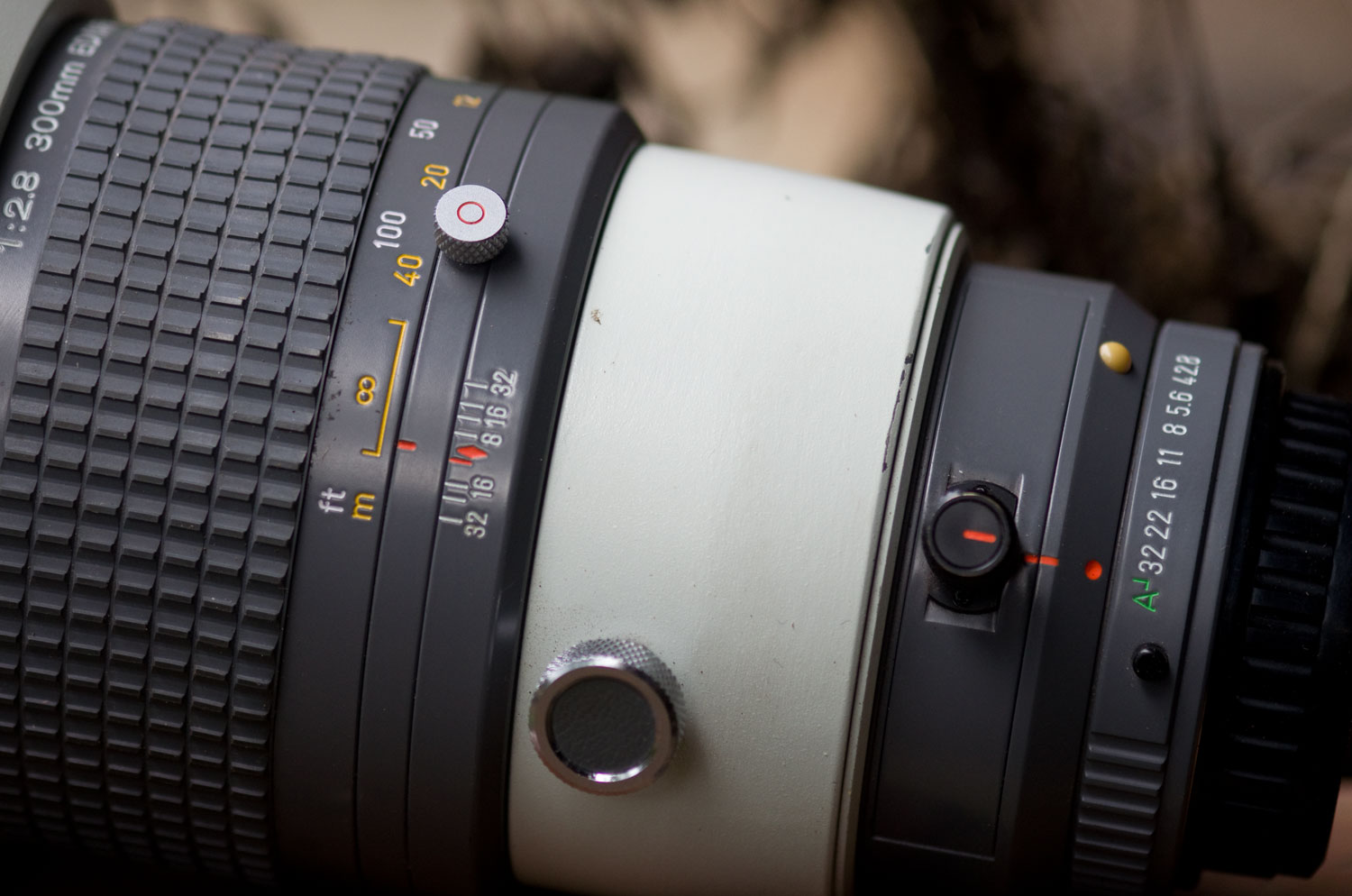
| Pentax A* 300 control area. The filter tray is on the right with the red hash mark. The center knob is for rotating the tripod mount, and the left button near the aperture control is an aperture stop. |
|
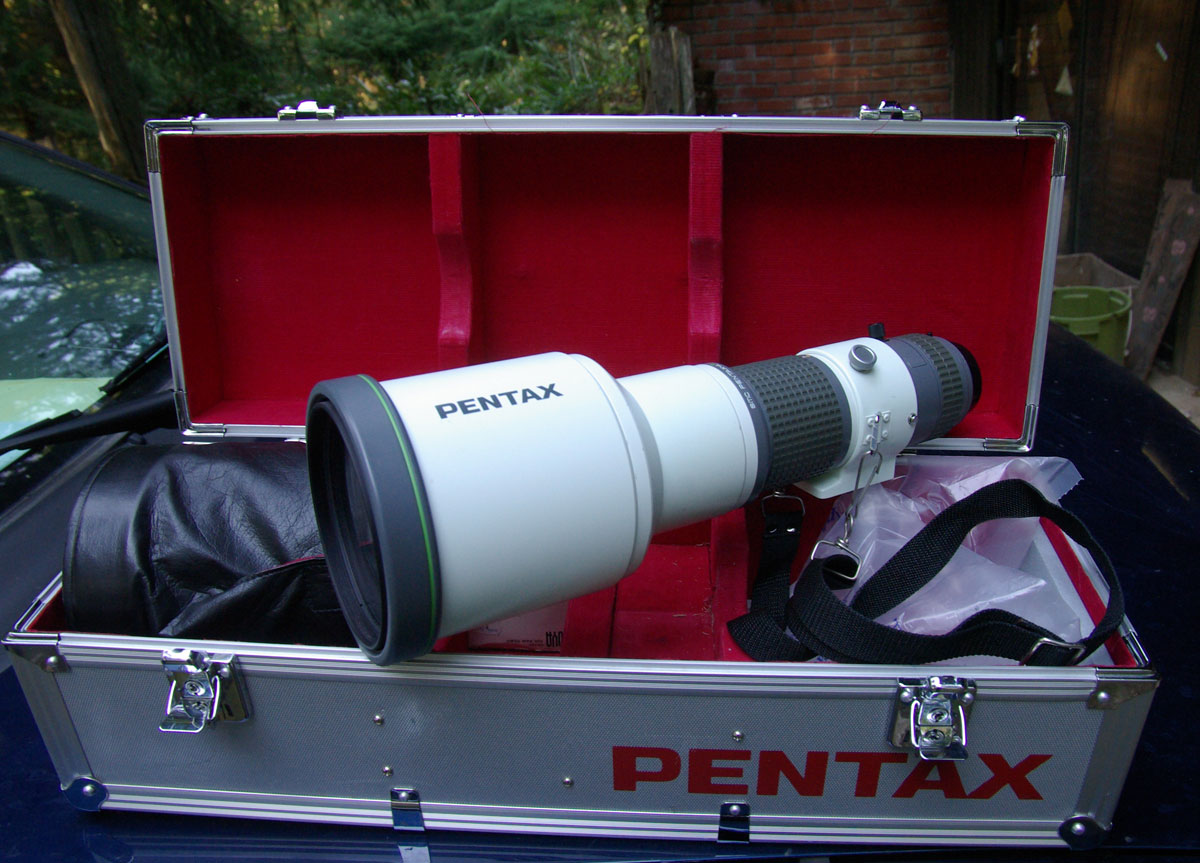
| Pentax-A* 400mm f/2.8 extreme telephoto. Introduced in 1984, this lens was available on special order until 2004. I acquired mine used in 2011. Although in good condition, it has been used extensively as evidence the wear on the paint. At 13.25 lbs, it is the fourth heaviest lens that Pentax has ever produced, out done by a long mirror lens and the 600mm f/4 lens and the 1200mm f/8 The weight is over double that of the 300mm f/2.8 above (2970 grams vs 6000 grams). This lens is particularly suitable for use with a converter because it is long and fast. With a 1.4x converter, you lose 1 f-stop and with a 560mm view it is stunningly close to a 600 f/4 for a lot less money. A stronger converter such as the f1.7x adapter or the 2x-L converter will provide performance similar to the 600 f/5.6 below but will reach further.. |
|
| Pentax A* 600mm F/5.6 Extreme Telephoto. This f5.6 lens is one the family is extreme telephotos that Pentax produced on special order in the 1980's. They are very long, very heavy, and of such a quality that they can be used with a converter for even longer lengths. This particular model was replaced with an even faster version--an f/4 600 mm. |
Background and Perspective
My photos start with a 1984 camera system, not because that is the beginning of SLR cameras, or even when I started using them, but simply because I have photos available of that era. Photography has been around since the 19th century and no effort is made here to present a comprehensive history of photography, or for that matter a comprehensive history of the Single Lens Reflex camera. I do need to define some terms, however, to make sense out of the recent history that I do intend to discuss.
Terms you need to understand.
- Single Lens Reflex (SLR:
- Fundamental to photography is the need of the photographer to determine what is being photographed. Solutions include a totally separate viewfinder or in some cases a separate lens for viewing. The latter is called a twin lens reflex. A single lens reflex or what is now usually just called an SLR camera has but one lens, and usually a mirror that hangs down behind the lens which allows the photographer to look out through the same lens that will ultimately be used for taking the photograph. When the photo is to be taken the mirror gets out of the way. Conceptually this allows any type of an optical device from a microscope to a telescope to be attached as a 'lens' and the photographer will be able to see what the camera is going to see.
- Rangefinder camera:
- Early low end cameras often just had a viewfinder which gave the photographer an idea of where the camera was pointed. If the optics were good enough to require or permit focusing this didn't provide focusing information. Argus on the low end and Leica on the high end for many years made range finders. These cameras had 2 view ports one on each side of the camera body and mirrors which superimposed one image on the other. You could rotate on of the mirrors until the images were not 'double'. The amount of adjustment provided a distance target for the lens focus. This worked fairly well for cameras that did not have interchangeable lenses.
- 35 mm Camera:
- Originally called 'miniature' cameras, these cameras got their start in Germany in the mid 1930's. The film format was around as it was the standard format for movies. The idea was to reduce the cost of photography by taking a strip of movie film and exposing it one frame at a time in a 'still camera' for snapshots. It was an idea that would remain popular for 65 years.
- Coupled light meter:
- Early light meters were separate pieces of equipment. First they were mounted on the camera, and later they were actually mechanically linked so the light meter reading would adjust the camera settings instead of providing information to the photography who was expected to adjust the camera for the correct exposure. The first linkages were made EITHER to the shutter speed control or to the aperture control. This is where the terms 'shutter priority' and 'aperture priority' came from. The photographer would set one manually, and the coupled lightmeter would set the other to provide the correct exposure.
- Program Mode:
- With the introduction of some intelligence into the camera it was possible to have the light meter set BOTH the aperture AND the shutter speed and select some intelligent combination. Since the shutter speed and the aperture setting are interactive some intelligence or a 'program' was needed to optimize the settings.
- Automatic (A-mode):
- In the Pentax world early coupled light meters were 'aperture priority' meaning that you manually selected an F-stop on the lens and the lightmeter coupled to the shutter would find a shutter speed that provided the correct exposure based on the F-Stop you hand chosen. When the "program mode" came along, there had to be a way to let the electronics choose the aperture setting. Pentax handled this gracefully by adding an 'A' (for automatic) position to the aperture rings on the lenses. When set to the 'A' position the camera could take control of the aperture settings. The featured 'Super Program' camera, known as the "Program A" outside the United States was the premier camera body to support this new feature beginning in 1983.
- APS-C:
- The film can that held 35mm film for 35mm cameras was developed in the 1930's. Camera and film makers hatched a plan to 'improve' the design in the 1990's by reducing the film size somewhat and putting it in a 'smart can' The design was suppose to allow smaller smarter cameras. The effort to pry consumers away from the 35mm format was generally not successful, but when SLR type digital cameras were introduced in order to make the cost manageable, they have generally used digital sensors of the APS-C size. The practical consequence of this to the consumer has been that the lenses all have a narrower field of view than they did with 35mm film. The 35mm frame is now called "Full Frame" or "FF".
Early 35mm SLR's
|
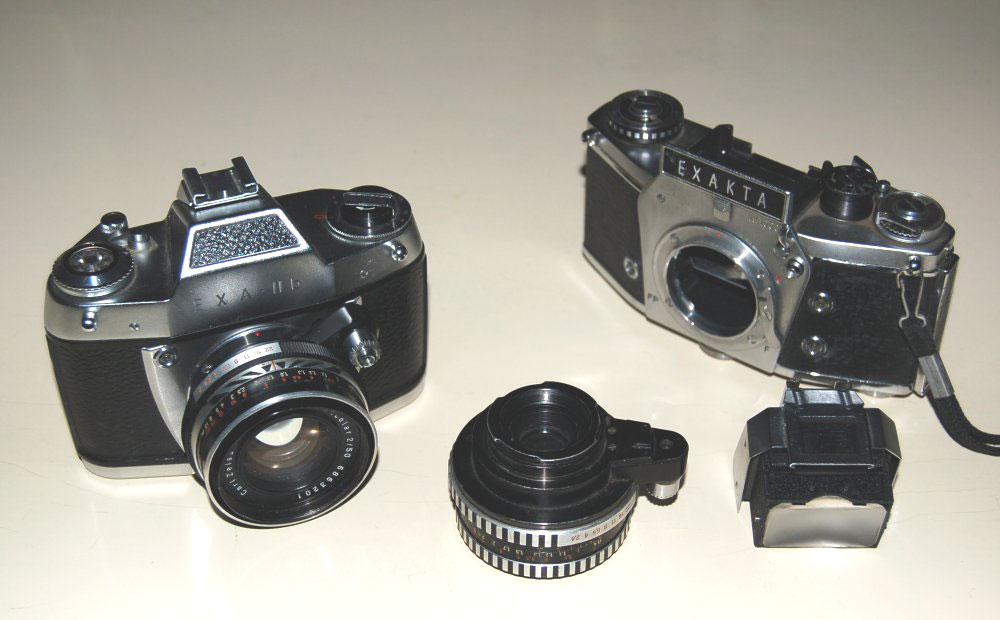
| Exa IIb and Exakta of the 1960's |

|
| Asahiflex IIA from 1957 with waist Level finder (now called Pentax) |
|
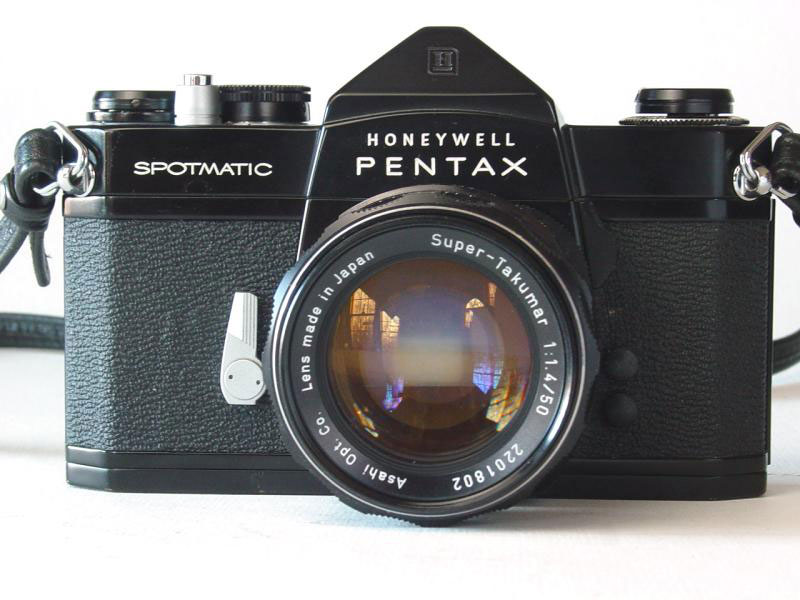
| Spotmatic as introduced in 1964. A Pentax legend for success |
Exakta of Germany is usually given the credit for popularizing the 35mm SLR camera with a successful model around 1936. The Germans had considerable experience with optics and clockworks, and the two combined made a camera. World War II ended production, and after the war the Exakta facilities being in Dresden were trapped in East Germany, and though production resumed after the way, innovation lagged and the leading edge for the development of photography moved to Japan. Never the less my first camera was a low end EXA IIa which I acquired around 1965 (The only photo I could find is of a Exa IIb which was similar, but as I recall had a higher maximum shutter speed. While made by Exakta, it did not bear their name as it was a low end model. It was fully mechanical--- no battery or lightmeter on it. It did have interchangeable lenses using the Exakta mount, an enclosed penta prism and a maximum shutter speed of 1/300. While you could set both the aperture and the shutter speed you needed a separate light meter or you needed to guess at the exposure. At that time exposure estimating instructions were printed on an instruction sheet boxed with every roll of film, (and later printed on the inside of the box) but really for most outdoor situations you could estimate quite well. The 'starting point' for estimating the exposure was a 'bright sunny day'. You would start by setting the shutter speed to the ASA (speed of the film). 'ASA' has since evolved to being called 'ISO' which is an exposure index more or less detached from the film but which still means the same thing. Thus if you had Ecktachrome 64 slide film in the camera you would set the shutter to 1/60 th of second. Then if it was a sunny landscape you set the lens to F/16. Cloudy bright got an F/11, Cloudy not so bright got an f/8 and dreary got an f5.6 or an f/4.
Pentax was one of the first out the gate with 35mm SLR's from Japan. There were in the market in theh mid 1950's ahead of both Nikon and Canon. The heyday of Pentax's importance and domination began in about 1964 with the introduction of the Spotmatic 35mm SLR. I owned one as my second camera. The light meter was fully integrated but not coupled. You got the right exposure by turning the aperture ring or the shutter dial until the light meter needle centered in the viewfinder. Pentax sold aa million of these in a few years.
Unfortunately, the lens mount which Pentax had borrowed from another European manufacturer, though simple was not up to supporting the next generation of cameras. It was just a simple thread mount. You simply screwed the lens into the front of the camera. It is often called 42mm screw mount reflecting the thread diameter. The immediate problem was that they needed at least 2 mechanical connections that would be very accurate in order to implement the next generation camera. The Screw mount had a single mechanical connection for 'stopping down' the lens. You see the lens needed to be 'wide open' for focusing, and needed to be stopped down so the light meter would know how much light was present when stopped down, and for the exposure. The Spotmatic handled this with a simple 'push pin' and a drive plate. The drive plate in the camera body flopped up and pushed the pin when the lens needed to stop down. The plate was fairly large and would work even if the lens wasn't screwed in exactly the same each time. However to make wide open metering work reliably they needed not only to be able to close the lens down on command but also to know where the aperture ring was set. This called for a different type of mount that would register accurately.
K Mount Replaced Screw Mount in 1975
In 1975 Pentax changed their lens mount from a screw mount to a bayonet mount. The bayonet mount (a twist lock) was called the 'K' mount and with various adaptations is still in use today. Indeed there exists a screw mount to K mount adapter which allows screw mount lenses to be mounted on today's cameras--even the digital ones allowing every Pentax lens ever made to be used on even Pentax's latest and greatest K10D digital body. "Used" does not mean used with all the features the newer lenses have. The K mount provided just the minimal functions required for the day---2 mechanical connections. It was to work for 9 years without change.
My third camera of significance was a Pentax K2. This was the top of the line model that came out with the introduction of the K mount in 1975. Though only made for a couple of years, it set the base for features expected of cameras of the day. In retrospect it was a transitional model. It was not only fully mechanical in that it would function as cameras had for years without a battery, it was also electronic, in that with a battery the electrics could take control of the shutter and set it anywhere from 1/1000th of a second to 8 seconds to provide the exposure chosen by the light meter. All you had to do was to focus and shoot. Results of course were better if you chose an intelligent aperture setting so the required shutter speed wasn't something ridiculous. The K2 did it all for the day, but was expensive because it was a fully mechanical camera within an electronic camera. I used mine for many years.
The K2 was soon followed by the M series for 'miniature' in which Pentax stripped out the mechanical shutter clock works and made the camera body very small--one of the smallest 35mm cameras of the day. the ME and the ME Super were popular and successful. Also on the low end there was the match needle K1000---an all time best seller that appeared and was successfully sold for over 20 years.
Super Program / Program A and KA mount
|
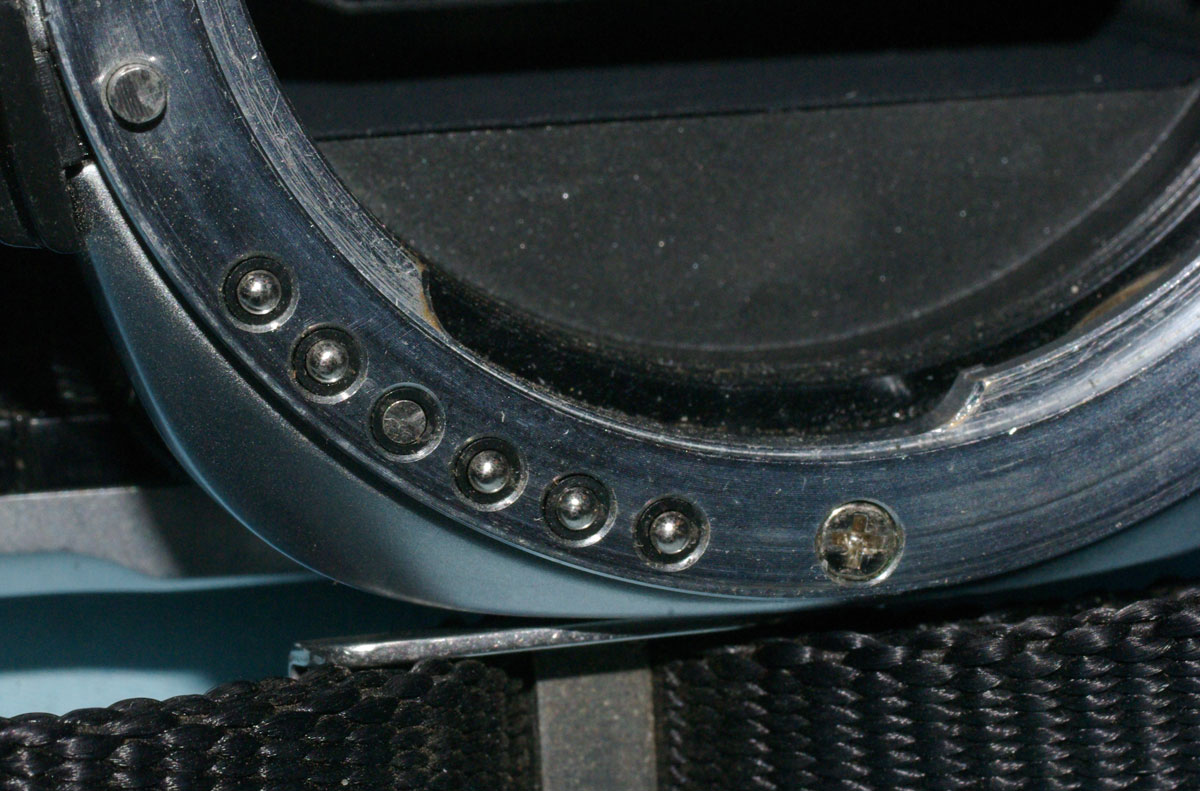
| The six contacts added in the KA mount. Only some contact anything on an given lens suggesting they are binary switches |
Pentax perhaps reached their apex with the introduction of the "Program A" or "Super Program" featured in the photos here in about 1983 or 1984. The 'A' series brought a modification to the lens mount by adding some electrical contacts, and the "A" position to the aperture ring. This allowed the 'program' cameras that determined both the shutter and aperture speeds so you only needed to 'focus and shoot'--a big technical step from the K2 design which required you to select a 'sensible' Aperture. However, I did not buy one of these right away. My K2 worked fine, and setting an aperture that was 'sensible' wasn't that difficult so I used my K2 (indeed until I dropped it and broke it) before buying a Super Program over ebay years later. The lens mount with the "A" position on the Aperture ring and the electrical contacts on the mount is known as the KA mount. Pentax has never explained how the series of contacts work on the KA mount but it is generally understood that they provide information relating to the F stop range that the lens is capable of. This third connection was required so that a program mode camera could tell when it was 'out of range' in setting the aperture.
In the late 1980's Pentax made a serious run at the profession photographer market with a full line of lenses from 180 degree fish eyes to extreme telephoto as long as 2000mm, but alas, Nikon and Canon rolled over the top of them. By 1990 Auto Focus was the feature to have. Pentax was an early announcer of a product that wasn't successful and sort of turned their back on the SLR market, instead making huge numbers of low end 'point and shoot' cameras. These small inexpensive cameras generally used 35mm film but did not have interchangeable lenses. Their SLR line was a succession of plastic looking bodies which were mostly forgettable. Although the F series lenses (for Focus) began to appear as early as 1987 (to be replaced with the FA series in a couple of years Pentax was having a hard time on the marketing end with their SLR product line. Though introduced in 1987 the auto focus was so poorly accepted that they continued to sell manual focus cameras for a decade until 1997.
Pentax finally got the bodies right with the ZX series in the mid 1990's (called the MZ series outside the US. While plastic, they were retro in appearance, and I happily bought a ZX5n in 1997 with autofocus, but that is for the next page as this page is about the 'A' series and the Super Program.
The family of 'A' series lenses is huge. Although they did not support auto focus, they were made well after auto focus became available and there are all flavors of primes and zooms. I show here just a few of them in a wide range.
It ranged from 'fish eyes' to an astonishing 1200mm f/8 conventional lens and a 2000mm mirror lens (2 of those heavier than my A*400 f2/8). Pentax also made a couple long zooms that went to 600mm though none were of the A class. As with the lateness of Pentax to the autofocus world they were late to the digital world which required some reworking of their lens family. They did not have to change the mount but the crop factor require a new set of short lenses. The practical effect of the 'crop factor' was to make the effective field of view 50% 'longer'. The longest current production lens for Pentax is presently a 300mm f/4, although the current roadmap calls for an da 560/f5.6 to be introduced in 2012.
Pentax-A series (SMCA) Manual Focus
Pentax accurately claims that effectively every Pentax lens ever made will work on current Digital bodies and it is mostly true, but there are some limitations. Pentax switched from the M42 screw mount to the K mount in 1975 and there are multiple variations of the K mount around as they have added features to it. The two most notable changes include the addition of communications between the lens and the camera body sufficient to support the program mode. Traditionally the lens aperture was set on the lens, and the shutter speed was set on the camera body, however wtih the advent of the "Program mode" cameras, such as the Super Program, the camera body took control of computing the suitable lens aperture. While the technology for closing the aperture was already present, in order to calculate the correct aperture, the camera needed to know the range of options available. The row of steel balls on the lens flange were added to pass that information. Lens families prior to the 'A' series were not set up to provide this information. Likewise they did not have the "A" position on the aperture ring which effectively alters the mechanics of the lens so the aperture can be set from the camera body. For this reason many of the exposure modes will not work with the pre-A lens familes, but happily they all work in the Pentax-A lenses. What you don't have in the A family is support for the Auto Focus, nor do the lenses communicate their focal length to the camera body.
The SR (Shake reduction) feature needs to know the focal length of the lens, so if you are using a Pentax-A lens (or earlier) you will be prompted in input the focal length of the lens manually when you mount the lens. Also there are emerging features such as auto lens correction, which depend on communications between the lens and the camera body which cannot be supported, but for the most part it is fair to think of the Pentax-A series lenses as fully functional and usable on the latest Pentax bodies in everyway except for the absence of auto-focus.
Pentax Golden Days
The 1980's were probably the Golden days of Pentax. They produced the Pentax LX, which was a professional grade body (which predated the KA mount upgrade, and during the 1980's Pentax released a whole family of professional lenses and exotic log lenses. These longlenses are still coveted today. If they have white paint on them and were sold with a trunk for a case they are among the exotic's.
- Pentax A* 300/f2.8 made from 1984-1998
- Pentax A* 400/f2.8 made from 1986-2004
- Pentax A* 600/f5.6 made from 1984-2000
- Pentax A* 1200/f8 made from 1986-2000