|
|
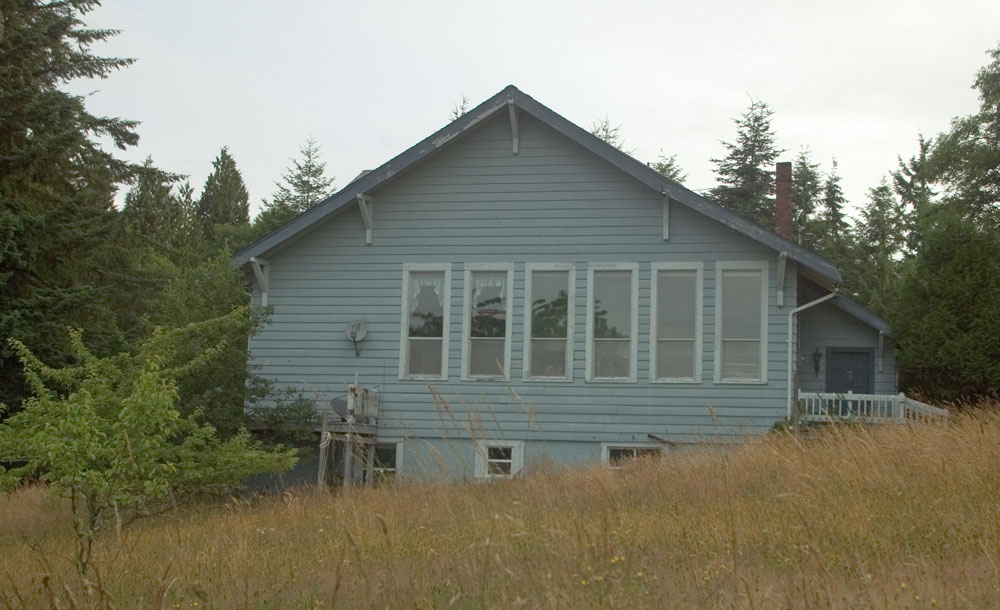
| Former Apiary School |
One of the most remarkable names in Oregon geographic history is Apiary, for a place about 8 miles southwest of Rainier. Apiary post office was established Aug 28, 1889 with David M. Dorsey first postmaster. The office was closed on March 24, 1924. The office was so named because Dorsey had a bee ranch. Apiary School District # 38 operated a sturdy 2 room grade school at Apiary for many years before it was merged into the Rainier School system in 1972. Dorsey's bee ranch was East of the Apairy school and was reached by a trail which was an extension of what is now known as 'Hammond Road'. Ultimately Dorsey sold out and W. L. Brown acquired the post office and moved it and a related store to his farm which was to the southwest of the school.
The original Apiary school opened for business in fall of 1890 with Nettie Mae Jones (later to be King) as the teacher, as it is reported that she married a school board member, William C. King on January 6, 1891. Will King was killed in a logging accident in Apiary on July 20, 1898. and is buried in the Bryant Cemetery now known as the Cedar Hills Cemetery (Clatskanie Area) in the Jones family plot along with a lot of his wife’s relatives. He had hooked a line around a dead snag for a tail-hold (logger’s language!) and, when he pulled on it, the snag fell and killed him. His homestead was in the Apiary area on the property owned by James and Nellie Swanson during the latter part of the century. Nettie was left with two small boys, Everett and Leo. She eventually moved back to Clatskanie and married her brother-in-law, Charles Boisvert, and to this union was born, Carl Willis Boisvert.
The family history authority for the Jones family writes
(in January of 2013): "I have 3
generations buried in the Bryant Cemetery now known as the
Cedar Hills Cemetery, (oldest cemetery in Clatskanie,
Oregon: my grandmother, gr-grandmother, and
gr-grandparents. There are 10 Jones relatives buried there,
but only 3 have tombstones. I once made temporary markers
for all 7 of the graves without markers – they lasted about
10 years and are all gone by now, Will King does not have a
marker. I once also paid to have my grandmother and my
great grandparents stones cleaned by a professional.
I met Everett King when he was quite elderly. I never met
Leo King, but I was friends for years with his daughter,
Dorothy King Miller and we worked on the Jones family
genealogy until she died. I became the family genealogist
for the Jones. Mom always stayed close to the Jones side of
the family as her mother, Dora Jones Graham, died when mom
was only 2 years old. Mom was about 22 years old when
Nettie died. It seems like if Will was actually reburied
that someone left living in the family would know about it
especially my mother and/or Leo’s daughter Dorothy.
I cannot remember a time in my life that the cemetery was
not part of every trip we made to Oregon. In fact in my
gr-grandmother’s family—out of father, mother, 3 daughters
and 2 sons, all died except the father and one son. The
mother (my great grandmother) died age 34, the 3 daughters
were ages 21, 16, & 14, and the 1 son died at age 2.
They all died of Typhoid Fever & Consumption and it was
the story of their deaths that got me started in genealogy
research. The 21 year old daughter that died was my
grandmother, and she had one child, my mother.
Sorry to be so long winded. I know this is far more
information than is needed. Since I got into genealogy so
young, I was able to take personally to a generation that
was gone shortly after I started in genealogy. It was only
much later that I learned how lucky I was to have started
into genealogy and to have the pleasure of knowing these
wonderful cousins.
Back to Will King. I think the fact that he is not
mentioned at all on the site for who is buried in the
Apiary cemetery proves that he was never buried there. Mom
told me that Nettie never got over his death even though
she married a 2nd time. Let me know if there I any other
info you would like and I will help if I can. The only
reason I was not raised in Oregon is that my mother went
through a divorce and came to Seattle to stay with her aunt
& uncle. She met my father in Seattle, and the rest is
history. Best wishes. Donna. ......"
Little is known about the building used or if it was on the same site as the later school, though this writer was told more than 50 years ago that the former building was on the same site as the existing one. There is general agreement that the present structure went to bid on April 25, 1918 with the winning bidder being Otis Kellar, who along with his brother,Homer Kellar, who was the district clerk, actually constructed the building. The following year they built an identical building for the Stehman School District. A hand dug well about 30 feet deep behind the school provided running water beginning in 1926. In 1940 electric power arrived and in 1948 the school got a telephone.
Apiary had a steam driven sawmill as early as 1911 according to newspaper reports. The precise location is a bit confusing to this writer as the mill was also said to be on the Clatskanie River which except for the North Fork of the Clatskanie is several miles away.
Today the Apiary Road is better known than the community itself. The Apiary Road is a north-south link interconnecting the Nehalem Valley to U.S. Highway 30 just West of Rainier. In the grand scheme of things the Apiary Road is a vital link in the only westerly bypass of Portland and all points north in Washington State. Traffic is able to depart I-5 and Longview, cross the Lewis and Clark Bridge to Rainier and proceed south to the Nehalem Valley, Vernonia, and ultimately all points in the Western Willamette Valley. Wood products moving to market points along the east side of the coast range use this route extensively meaning that chip trucks, lumber wagons and log trucks travel this road in herds. The Apiary Road, some 17 miles in length traverses a number of watersheds. Starting from the North, it climbs a small rise after leaving Old Rainier Road which follows the main stem of Beaver Creek and soon joins the South Fork of Beaver Creek and follows it up to its source just short of the Apiary School. It then crosses the North Fork of the Clatskanie so near its source that it is seasonal in flow, at at the intersection of Fern Hill Road clears a pass and heads down Buck Creek and finally reaches the main stem of the Clatskanie River near the confluence of the Little Clatskanie River. It then follows the Clatskanie River upstream for several miles crossing it in the process, finally breaking away and heading for the Enterprise summit. The it breaks over the divide departing the Clatskanie River and heads downhill quickly finding Oak Ranch Creek which it follows to the Nehalem River where it ends with in intersection with the Nehalem River Highway there also known as Oregon Route 47.
As a main travel route from the Nehalem Valley north to the Columbia River, the Apiary road effectively replaces the 'Enterprise Trail', which was an early settler route from Goble to the Nehalem Valley. In the late 19th century Goble was an important rail head and the ferry crossing for rail traffic to Tacoma making it a significant transportation link. The Enterprise trail was opened in the late 1880's to connect the Nehalem Valley, to the Enterprise Landing, which was the name of a river boat landing near what is now Goble or more precisely probably closer to "Reuben" a mile or so upstream from the townsite of Goble. The name "Enterprise Landing" dates at least back to 1879, and did not have a post office as people simply went accross the river to Kalama to get their mail. As such it predates the arrival of the railroad which arrived in Goble from Portland on October 1883. (Rail service was extended to Seaside on May 7, 1898). The first Post Office in the Goble area was 'Hunters' (also known as Hunter's Point) established May 28, 1888 with Pete Hunter as postmaster, which was closed to Reuben in October 1893, whereupon Reuben Foster became postmaster. "Hunter's Point" is also referenced at the location of the Northern Pacific Railroad ferry slip.
The development on the Kalama side of the river started much sooner. The Northern Pacific Railroad got congressional land grants for a transcontinental Railroad to tidewater on Puget Sound. They began building in two places---Minnesota west, and at Kalama north in 1870 or 1871. By 1874 they had reached Commencement Bay (now Tacoma) where they established the 'tidewater terminus' and rail service from Kalama to Tacoma began on January 5, 1874. One way service was $6 and $1 more for the riverboat to Portland, about the time that the Northern Pacific went broke and was taken over by Henry Villard who also controlled the Union Pacific. Construction was started on the Portland-Kalama section of trackage in about 1882 but lagged to to labor shortages. The contractor for the Hunter's Point-Portland section of track sent a famous telegram to Henry Villard on September 13, 1883, declaring that "You now have Rail" though it is unclear if the track was actually completed (The Eastern and Western Divisions of the Northen Pacific had previously joined on August 23, 1883 50 miles west of Helena, Montana, making the belated completion of the Portland-Hunter's Point (Goble) section, the actual 'completion' of the Minnesota to Tacoma Northern Pacific Railroad. The great celebrations of the completion of the Northern Pacific were held in Montana, not Goble, however. Ironically, Villard's control of the Northern Pacific collapsed immediately thereafter and by January of 1884 Villard was out. The Northern Pacific had gotten down the Columbia River Gorge at the time with a joint operating agreement with the Union Pacific, which they wanted to bypass, and in the summer of 1887 Northern Pacific opened their tracks over Stampede pass effectively bypassing Goble and Kalama with direct service over the Cascades from Eastern Washington to Western Washington, though it would be December 25, 1908 before Goble was completely bypassed by a railroad bridge across the Columbia River at Portland.
Though there was no 'Enterprise' the Enterprise trail name stuck, and that route started out following the Nicoli road generally to Shiloh Basin where it took the route of the Clark road past the Coble cemetery eventually getting to the Meisner Road at the Clark road, then taking Hollywood road, and generally reaching the Clatskanie river about where the Apiary road departs the Clatskanie River and heads for the Enterprise summit. Though the exact route is not recorded, the Enterprise trail went west along the divide between the Clatskanie and Nehalem Rivers, and then turned south near the Enterprise Lookout and went down the ridge between Oak Ranch Creek and Cedar Creek, arriving at the Nehalem River very nearly where the Apiary Road does. For what it's worth the South end of Apiary Road used to be called Oak Ranch Creek Road, but somehow the named changed in the latter part of the 20th century.
See also The Columbia County Historian's take on Apiary and Apiary School history
The historic Deer Island Logging Company Camp 9 was located in the hills just south of Apiary and was active in the late 1920's. Logging history is in another section of this web site, and includes a photo of Camp 9.
Note: The only known apiary in Apiary now is one maintained by Fred VanNatta which has been continuously active since 1950.
Verna Kellar of the longtime Kellar Family of Apiary assembled this information on the history of Apiary during her lifetime:Post Office: The Apiary Post Office was established in 1889. The first Post Master was Mr. Dorsey. Mr. Dorsey kept bees - That is how the post office and community derived its name: The Apiary Community continues to be Apiary today in 2002.
The post office building was located in the midst of virgin timber between the Homer and Jennie Kellar property (40 acres) and the school house which is one mile as the crow flies, was located a few yards away. Charles Buck was the 2nd Post Master. Mr. Buck was a relative of the Dorsey family.
William Brown was the 3rd and last Post Master of Apiary. The Post Office set between the Brown's and the Kirmesches home. The mail came from Rainier two times a week; Wednesday and Saturday.
Mrs. Low and her sons, Ed and Charles Brough brought the mail by horse and buggy or on horse back depending on the weather conditions. They traveled the old punching from Rainier . The substitute mail carrier was Mr. Marshall. The post office was a very popular place on mail days as neighbors visited one another besides looking for letters from their loved ones. The Apiary Post Office was discontinued in 1923 when the rural mail route was established. Fern Hill Grange #592 was instrumental in securing a mail route.
School: The first term of school was held at Apiary in 1891. Nettie Jones was the first Apiary school teacher. The school building was located near the Lowman home. The Apiary School district was granted in July 18, 1892 . Later the school building was moved to the present site. The building was the hub for all community activities including a Literary Club in 1916 to elections, Sunday school, church, pie socials, funerals, debates, dances and more. Young and old alike took part. The present school building was built in 1917 by Orris and Homer H. Kelllar. Orris drew the building plans and was given the contract to build. The district #38 is now consolidated with Rainier . Orris and Homer H. Kellar also built the Stehman School house in 1918 using the same plan as Apiary's other than the entrances. The Stehman building burned in 1965 and it was not rebuilt.
The Fern Hill School building was granted in 1916. It was built in 1915, the same year that the Homer H. Kellar's moved to Apiary from Wisconsin . The Fern Hill Grange was organized in the school house May 24th, 1920 and met there until November 2nd 1921 . Brother Homer and Sister Jennie Kellar were the last charter members of the Fern Hill Grange #592.
The Grange purchased a church building and half an acre of land from the Methodist Church Association of Rainier. This building was moved by the aid of a stump puller and a team of horses, down the hill across the Skeans property to the Grange site across the road from Bob Skeans. There was no building there at that time. Our first meeting was held in this building.
Our new hall (November 12, 1921) was the community center for business and social functions including the Apiary precinct elections. Homer H and Jennie Kellar both serve many years on the election board as well as being officers of the Grange the Apiary School Board. The general election board was somewhat different from today in their duties. There were five members who served on the board until recent years. The board worked all day registering voters and counted the votes after eight o'clock - closing time. Some years it was day light before the counting was finished. Ballots were not printed as today; the board had to write for hours. The Board had the power to register voters and also handle absentee ballots. On year my husband, Brother Homer Kellar, took an absentee ballot to Jarred Wilson. Brother Homer served on the Apiary election board from 1916 to 1948 when he resigned after 32 years.
The church hall was sold to Columbia County for a rock pit and the present Grange Hall was built in 1927. Three meetings were held in Willborn's hay barn before our present Grange Hall was finished, The first meeting was held August 13,1927 in our unfinished hall.