
|
|
|
|
It is tempting to assume that a bulldozer is a bulldozer when it comes to to the optional accessories. This is not quite the case however. Every manufacturer offers a variety of attachments for the basic dozer to help user adapt the machine to the particular application. On the rear of the machine you will find very commonly either a ripper or a winch, although in the logging industry sometimes grapples are provided.
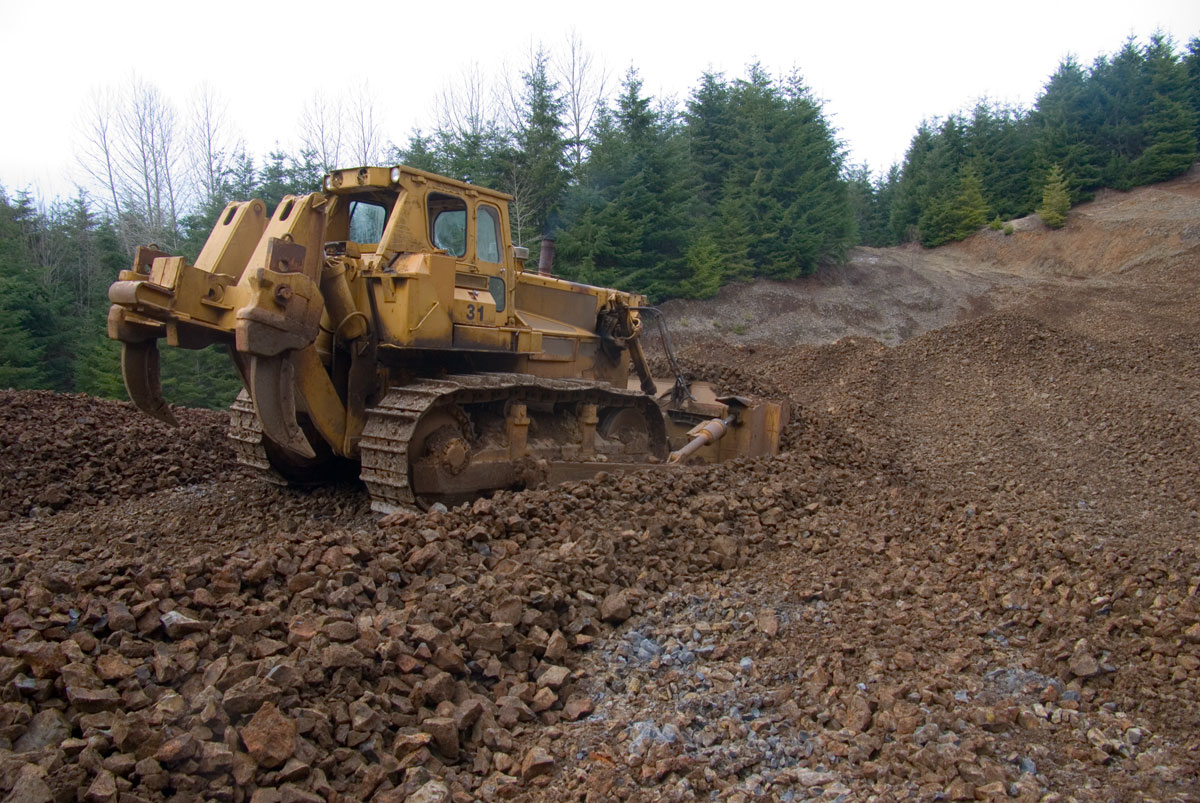
The larger dozers (200 HP and up) usually have rippers because these large machines are most at home in quarrying, and strip mining applications. The ripper is useful in loosening up the ground so that the blade will be able to penetrate and fill quickly. The rippers are able to penetrate where a blade will simply scrape along.
Larger heavier dozers will rip rock that lighter machines won't touch. This is mostly a function of their weight. The ripper points tend to be about 4 to 6 inches wide. Heavier dozers provide more pressure due to their weight which means more penetration. Ripping Rock is a bit of an art form. Unfractured formations of basalt rock such as are sometimes found around the Pacific Northwest simply don't rip regardless of the size of the dozer applied, but unfractured formations are rare, and he challenge is to know your rock well enough to predict whether it will rip or and and if so, with what.
Quarry engineers will have access to a seismograph to measure the density of the rock, but the traditional approach is to stick the ripper to the rock and see what happens. If the result is approximately nothing, you look for a bigger dozer or go somewhere else or call a powder monkey to drill and blast it.
There are several designs of rippers around which have their place:
|

|

|
As you might guess, this list is an odd blend of at least 3 different features and / or characteristics of a ripper and various combinations of these features may appear. The 'hinge/parallelogram' construct is a comment on the geometry of the way the ripper lifts. The hinge rippers are almost completely obsolete today and refers to a type of ripper that just swings out of the ground on a hinge near the back of the dozer. The problem with this design is that the ripper point never has the right angle of attack except when the ripper is at the intended depth. This means that they don't work optimally under difficult conditions where the amount of penetration may be variable.
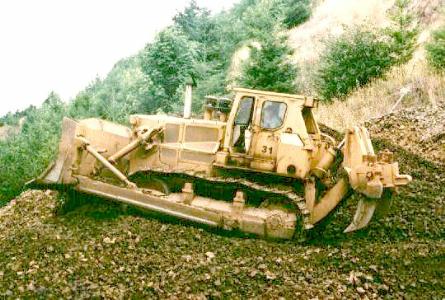
By contrast the parallelogram ripper is double hinged so the ripper bar will move straight up and down maintaining the tooth alignment over a wide vertical range. The linkage is a parallelogram which simply becomes more acute in its angles as the ripper is lifted. All of the photos here are of parallelogram rippers.
The 2 vs 4 barrel difference in rippers is harder to understand till you see it spelled out. the reference to 'barrel' refers to 'hydraulic cylinders' A 4 barrel ripper will have 4 hydraulic cylinders on it. A pair of them will be placed diagonally across the parallelogram to raise and lower the ripper bar by pulling the upper front and lower rear corners of the parallelogram together, etc. These are the only 2 cylinders on a 2 barrel ripper. On a 4 barrel system, the upper linkage will also be hydraulic cylinders. This permits the operator to adjust the angle of attack of the ripper points. This is critical in hard ripping because as the point wears you can adjust it to get a new bite. This will greatly extend the useful life of the ripper points which are both expensive and extendible. Under difficult conditions, ripper points may last only a few hours.